


Haeslios
Haeslios is a dragon’s wing of stone and story, flung wide against the western seas. To stand upon her cliffs or walk her river-vales is to feel that the land itself is mid-gesture—caught between the memory of fire and the patience of green things.
What follows is a complete description of the continent as prepared by the Lyceum of the Ancients, adapted for Myth Keepers at the table. Read it not merely as a gazetteer, but as a living partner in your tales.

The Shape of a Dragon’s Wing
Cartographers agree: when traced upon a globe, Haeslios resembles a wing unfurled. The broad western edge is ragged with archipelagos, like torn feathers dipped into storm and mist. The central mass tapers eastward into a graceful curve of cliffs and bays along the Myrrh Sea, while the southern Sunlit Peninsula descends like a talon toward warmer currents.
Tectonics and Stone-Memory
Beneath myth, Haeslios rests on a stubborn plate of ancient stone, buckled and twisted by three great convulsions:
-
The First Raising – In the remote Flame Epochs, the Iron Spine was thrust skyward: a north–central cordillera of jagged peaks, basaltic spires, and glacier-chewed cirques. The Draconid, Nican, Atharid, Tharid, and Ucitish realms all cling to, or crown, this mountainous backbone.
-
The Western Shatter – Later, a combination of tectonic pressure and magical overburn fractured Haeslios’ western edge into the Western Isles. These archipelagos—Apaetor, Tuvarian, Yucaea, Geaburg, Braevarian, Ounicorid—are the remnants of a once-continuous plateau. Their cliffs still show matching strata, like pages torn from the same book and scattered by the sea.
-
The Eastern Lean – Gradual subsidence along the Myrrh littoral created the eastern escarpments of Leodor and the low, drowned deltas of Haeslion. Here the stone falls sharply into deep, blue trenches: the Myrrh Sea is younger and far more temperamental than the Western Ocean.
-
The Heartland Downs - home to Pithage, Bregalla, Gearis, Megary, Haeslion, Ayles, and parts of Leodor—are the worn shoulders between these events: rolling chalk and marl, fertile alluvium, and deep, copper-veined subsoils that remember both mountain and sea.
Archivist Vayne writes: “Haeslios is not one thing but three: a mountain trying to stand, a shelf trying not to fall, and an island trying to be a continent.”
Waters that Hold the Wing
Haeslios is defined as much by the waters that cradle it as by its stone.
Western Ocean
To the west stretches the Western Ocean, a cold, iron-gray expanse that drinks the winter sun early and gives it back as storm. Great rolling swells march in from the far horizon to smash against Geaburg’s skerries and the Braevarian cliffs. Icebergs, fractured from Ucitish shelves, drift southward in late winter like white citadels in slow procession.
The Western Ocean is the graveyard of fleets and the cradle of songs. Yucaea and Geaburg sailors swear that if you listen beneath the roar, you can hear the drowned verses of oaths broken at sea.
The Myrrh Sea
To the east lies the Myrrh Sea, warmer and more temperate, fed by the Alyth Current that curls from Ayles’ coast and bends southward. Its waters smell faintly of resin and spice, thanks to endemic kelp and the sap-rich cargoes that sail its trade routes.
Jagged submarinal ridges make the approaches to Skyglass Strait treacherous: charts are essential, pilots mandatory. In clear autumns, the aurora and Skyglass dream-light reflect off mist and water, making the horizon appear to slope upward, as if the sea were trying to climb into the sky.
The Sunwake Gulf
Southwards the coastline dips to form the Sunwake Gulf—a wide, bright bight beneath Sasta and Crican. Here the water is shallower, the color shifting from jade to gold in the afternoons. Summer cyclones spin up off these warm waters, feeding the famed Stormlace of lightning along the southern rim.
The Ninefold Waters of Oratish braid into the Sunwake through a lacework of estuaries and tidal marshes, while Sasta’s cliff-forges and war-harbors loom above storm-churned surf.
Channels, Straits, and Currents
-
The Emerald Channel is part river, part sea-sound, separating southern hill-countries from the central coast. Silted bars and hidden rocks make it a pilot’s trial, but its emerald-tinted waters are sacred to Oratish river cults.
-
The Skyglass Strait between Leodor and the northern skerries is a narrow, fog-bound choke point where dreamlight from the Skyglass Tower fractures navigation stars.
-
The Alyth Current sweeps along Ayles’ coasts, a major conveyor of trade, wreckage, and rumor. Ships that misjudge its strength find themselves pulled either toward Skyglass rocks or Sunwake storms.
In all these waters, Haeslios’ mariners read tides not only with lead lines and sextants, but with omens, dreams, and the shifting hum of the Mariner’s Arc ley-line.
Great Landforms of Haeslios
The Iron Spine
The Iron Spine is the visible manifestation of Haeslios’ oldest wounds. Its peaks claw from the Atharid Empire in the south to Draconid Empire in the north, with their chief mass between the Nican Dynasty and the Draconid Empire. Here we find:
-
Towering volcano-roots in Draconid and Atharid, some dormant, others venting steam and dragonfire.
-
High glacial plateaus in Nican and Ucitish, where snowfields creek and groan like slumbering giants.
-
A labyrinth of serrated ridges and knife-edged cols in Tharid, overlooking the Myrrh’s eastern storms.
Iron, nickel, and rare aether-metals lace the Spine’s bones. Dwarven forges, draconic lairs, and monastic fastnesses honeycomb its depths.
The Aurora Line, a great leyfire current, rides this cordillera, and on cold winter nights the sky above the Spine becomes a shifting curtain of green and violet—seen, revered, and weaponized by the realms that call these heights home.
The Heartland Downs
South of the Spine, the land relaxes. The Heartland Downs are a quilt of rolling hills, open fields, fertile river valleys, and low uplands. Chalk escarpments break the horizon; beech and oak woods crown the higher ridges.
-
Pithage uses the Downs’ stability as the stage for law and decree.
-
Bregalla builds libraries and citadels where the Spiral Line hums beneath a calm surface.
-
Gearis tends deep, ancient forests rooted in valley loam, their oath-trees fed by mineral-rich streams.
-
Megary blankets gently sloping plains with grain and flax, anchored by irrigation channels that flash like silver threads at sunrise.
This is where roads are straightest, fields most regular, and cities most numerous. Yet the Downs are not tame; ley-flares, ancient barrows, and hidden sinkholes remind travellers that this land is as old and willful as any mountain.
The Sunlit Peninsula
To the south the Sunlit Peninsula thrusts into the warmer seas: moors of heather and gorse, weather-beaten highlands, and wind-gnawed cliffs. Beneath their golden light lies hard, resistant stone—a mix of granites and metamorphic bedrock that has outlasted entire empires.
-
Sasta occupies the eastern faces, where stormfronts batter cliff-forges and lightning is caught in bronze spires.
-
Oratish holds the central highlands and river gorges, where the Ninefold Waters carve deep clefts toward the Emerald Channel.
-
Crican keeps the western capes, low, bog-edged moors and salt-marshes where the Stormlace line kisses the surf and bell-towers mark the rhythm of tides.
Here geology and weather conspire to harden those who dwell: stone is close to the surface, soil thin and wind-flayed, but rich in metals and secrets.
The Western Isles
The Western Isles are the shattered feathers of Haeslios’ wing: long, rough chains of rock rising from deep oceanic basins.
-
Apaetor’s isles are green, stone-ringed, and cloaked in mist. Dolmens, standing stones, and ancient chorus-rings crown many hills.
-
Tuvarian’s domains are dense with primeval forests, their roots gripping thin soil over jagged rock, opening into sudden sea-cliffs.
-
Yucaea sprawls across coral and volcanic islands where lagoon and open sea mingle.
-
Geaburg and Braevarian tower higher: their cliffs are fortress-walls of basalt and granite, rich with ore.
-
Ounicorid occupies a gentler plateau of low, grassed hills and quiet harbors, the calm eye of a storm of myths.
These islands are where Haeslios remembers she could have been many smaller lands instead of one. Magic and weather both fracture easily here, echoing and amplifying across narrow channels.
The Leyfire Lattice
Haeslios is veined with leyfire, shimmering serpentines of geomantic energy. While countless minor lines run beneath its soil, five primaries structure its magic and history.
The Aurora Line
Running NW→NE across the Iron Spine, the Aurora Line binds Draconid, Nican, and Atharid. It sings loudest at the Aether Spire Node in Draconid and at the Crystal Bastion Node in Nican.
Here the sky itself becomes a spellbook. Dragon sorcerers, storm-priests, and high geomancers gauge the intensity, color, and rhythm of the aurora to predict ley-surges, fey migrations, and even omens of war. The line also enhances metalwork and enchantment; Draconid blades and Nican mirror-wards are renowned across Gaea.
The Spiral Line
The Spiral Line drops north to south from Tharid through Pithage and Bregalla into Sasta. It threads deep into the continental crust, associated with memory, ancestry, and lawful binding.
Its anchors include:
-
The Gate of Ashen Wings Node (Tharid) – a sentinel node that flares at the scent of invasion.
-
The Obsidian Archives Node (Bregalla) – where knowledge congeals into living ink.
-
The Spiral Sanctum Node (Haeslion) – where ancestry can be read in spirals of light.
-
Echoes in Pithage’s White Senate chambers and the Tempest Collegium in Sasta.
When the Spiral Line flares, old oaths awaken and forgotten bloodlines stir. Many dynasties have learned, too late, that the land remembers promises they wish had been forgotten.
The Runeflow Line
The Runeflow Line tracks the Vael and its kindred rivers from Pruryn through Gearis to Apaetor. It is associated with words, oaths, and the fluid power of names.
Its major manifestations:
-
The Flowing Forge Node in Pruryn, where molten metal can be inscribed with runes mid-pour.
-
The Root Court Node (Gearis), where oaths are tested against the living truth of the forest.
-
The Choir of Lir-Fane Node (Apaetor), where sung law and story shape reality.
Where the Runeflow intersects culture, druid-legates, bards, and rune-priests hold substantial sway.
The Mariner’s Arc
Curving from Yucaea through Geaburg to Ayles and Leodor, the Mariner’s Arc governs tides, navigation, and the whispering memory of the sea.
Key nodes include:
-
The Hall of Seven Currents (Yucaea), where currents are braided by ritual.
-
The Storm Ring Node (Geaburg), a permanent lightning halo over stone circles.
-
The Hall of Maps Node (Ayles), where charts correct themselves.
-
The Skyglass Tower Node (Leodor), which sweeps dream-light across the waves.
It is said that no ship wrecks along the Arc without the sea itself having an opinion about it.
Stormlace
Finally, the Stormlace Line stitches the southern coast through Crican, Oratish, and Sasta. It manifests as chains of lightning, harmonized thunder, and eerie clarity between storms.
Its focal points:
-
The Tide-Bell Monastery Node (Crican), where bells ring in exact step with lunar tides.
-
The Stone Bridge of Varrin Node (Oratish), where truths cannot be lied across.
-
The Tempest Collegium Node (Sasta), where storm-singers train to conduct entire weather fronts.
Stormlace tightens during the Sunwake cyclone season, making the south both hazardous and strangely predictable.
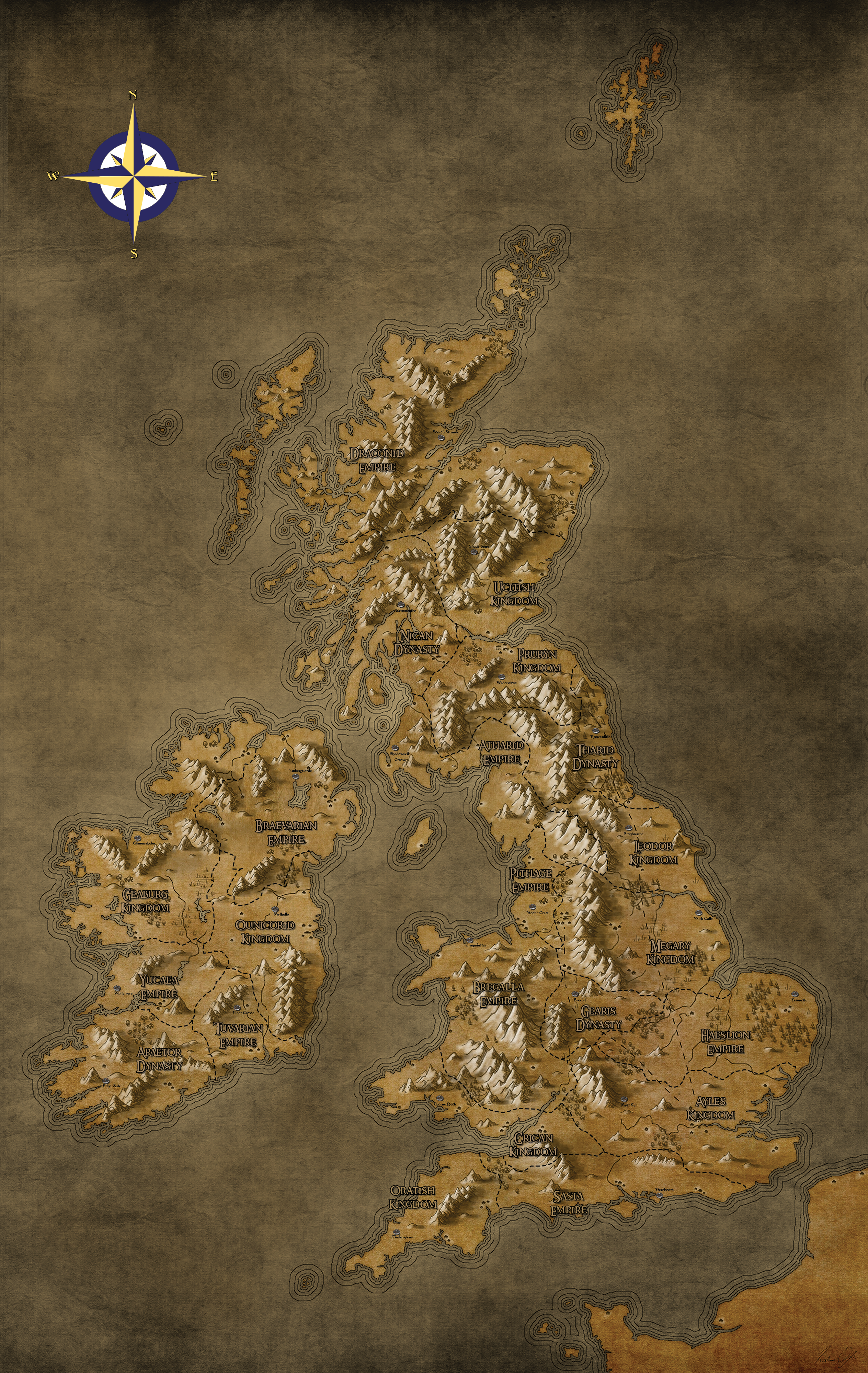
Realms of Haeslios by Region
Northern Haeslios — Peaks, Frost, and Auroras
Draconid Empire
The Draconid Empire is a realm of razor-backed ridges, calderas, and glacier-cut valleys. Volcano-roots vent steam into skies lit by the Aurora Line; dragons nest among obsidian crags and basalt amphitheaters.
Its capital, Vyranthium, crowns a plateau near the Aether Spire Node, a city half-carved, half-grown from black glass and dragonbone. Runic metalwork, spell-forged panoply, and fire-tempered law define Draconid culture.
Borders are steep and jealously guarded: to the west by Atharid, to the east by Nican, to the south by Tharid. Access is controlled via the Sky-Fang Pass and the seasonal Wyrm-Stairs. Even in peace, caravans travel under draconic escort or not at all.
In play, Draconid is the home of mythic metallurgy, dragon politics, and high-altitude warfare.
Nican Dynasty
West of the Draconid Empire, the Nican Dynasty faces the Western Ocean across frosted cliffs and fjords. Here, taiga and tundra mingle with jagged shelves of ice. Nican settlements cling to sheltered coves and narrow valleys. Their people are seafarers, ice-fishers, and reindeer herders, with sagas carved into cliff faces where paint would freeze and flake away.
They share aurora resonance with Draconid but lack major nodes; their magic is diffuse, a low hum instead of a thunderclap. The Frost-Ferry Fjords are their lifeline, connecting them to Atharid via the Nine Winds Stair.
The Nican are proud of their isolation. Their warriors ride bone-sleds down glacier faces, and their law-speakers recite codes that trace back to the earliest Flame Epochs.
Ucitish Kingdom
To the east lies the Ucitish Kingdom, a highland realm of refractive crystal, sun-glittering snowfields, and mirrored lakes. The Crystal Bastion Node saturates the land with light-born magic.
Ucitish engineers have shaped entire peaks into faceted mirror-citadels that focus aurora and sunlight into healing beams and warded barriers. Bridges are often glass-arched, laced with runes to redistribute stress; roads cling to cliffs in impossible lacework of stone and light.
Prism Gate connects them to Pruryn, while Sky-Fang links them to Draconid. Their power lies in knowledge of reflection—optical, political, magical.
Pruryn Kingdom
Descending slightly south, the Pruryn Kingdom is the cradle of the River Vael and the heartland of the Runeflow Line. Deep valleys funnel snowmelt into roaring rivers that carve canyons and nourish rich lower meadows.
Pruryn’s cities cluster along stepped terraces above the Vael: each level linked by locks, lifts, and rune-carved spillways. The Rune-Weir Locks guide barge traffic; every gate is inscribed with law.
Pruryn culture fuses Nican crystal lore with river practicality. Their artificers specialize in devices that harness both water pressure and ley currents: mill-libraries where every turn of the wheel writes a new line of data.
Atharid Empire
On the western flank, the Atharid Empire straddles the boundary between mountain and Sea. Its basalt switchbacks rise from storm-hollowed coves to high, wind-thrashed plateaus.
The Storm Throne Node sits near a natural basalt dais ringed by standing stones that crackle with bound lightning. Atharid kings are crowned there during thunder, their oaths sealed in static charge.
Atharid courts meet at night, when the glow of the aurora reflects in black waves below. Their justice is swift and harsh, like a storm breaking over a calm sea.
Tharid Dynasty
To the east of Pruryn and south of Draconid, the Tharid Dynasty occupies a string of ridgelines and high cols overlooking the Myrrh Sea.
The central feature is the Gate of Ashen Wings Node, a broad mountain pass flanked by cliffs shaped—by nature or artifice—into winglike buttresses. When incursion looms, the node’s leyfields flare, and ash-colored sparks sheet across the sky.
Tharid is a border realm by nature: its culture emphasizes vigilance, ritualized hospitality, and a wary diplomacy with Nican, Pruryn, and Leodor. Crownroad patrols are elite, winter-hardened companies who consider themselves the first and last line of defense for all Haeslios.
Central Haeslios — Heartlands of Law, Faith, and Grain
Pithage Empire
The Pithage Empire dominates the central northern Downs. A realm of marble forums, ink-stained scribes, and exhaustive codices, Pithage uses the land’s gentle relief to create monumental avenues and perfectly aligned processional routes.
The Spiral Line passes beneath its capital, Tarsen-Hall, lending gravity to every decree. The White Senate meets in a ring of stone whose acoustics are so perfect that lies are said to tangle and become audible.
Paved Edict Roads radiate outward, each milestone carved with both distance and relevant laws. Pithage’s influence extends far beyond its borders, since those who control the rules of the road quietly shape the world.
Bregalla Empire
The Bregalla Empire sits at the meeting of Spiral and Heartland. Its capital, Cragminster, is a rock-walled bastion whose towers look inward as often as out, toward the depths of the Obsidian Archives Node.
Here, knowledge is not only stored but animated. The Archives’ living inks creep along pages and walls, rearranging themselves when new truths are discovered and old lies exposed. Scholars require special seals and training to enter the deeper levels—lest their own memories be rearranged.
Bregalla is intensely urban, built around guilds, colleges, and battalions of legal scholars who walk a fine line between Pithage law, Gearis oaths, and their own imperial ambitions. The Crownroad and Golden Way converge here, making Cragminster the logistical heart of the continent.
Gearis Dynasty
East of the Bregalla Empire, the Gearis Dynasty rules deep, ancient forests and living border-woods. The boundary between Bregalla and Gearis is literally alive: a living hedge of oath-bound trees and sentient thickets known as the Oath Fringe.
At the Root Court Node, roots form natural benches and arches, and the air thrums with the heartbeat of the forest. Oaths spoken here are tested against the land’s memory; falsehoods sour the soil and call down punishment.
Within Gearis, Oath-Gates of woven, living wood recognize those who have sworn properly and open freely to them. Trespassers find themselves tangled, slowed, or politely ushered back where they came from—at first.
Megary Kingdom
Megary is the breadbasket of Haeslios. Broad, gentle plains stretch away in tidal waves of grain, their monotony broken only by irrigation channels and granary towns.
The land here is rich in silt, sediment deposited by older river systems and shaped by cautious human intervention. Irrigation chaussées serve as both dikes and roads; in flood season, distant fields become shimmering, geometrical lakes.
Megary is pragmatic to its bones. Its power lies in surplus: grain, oil, and fodder that feed armies and cities. Yet beneath the surface, secret Spiral sub-threads in the Sun-Root Vaults tie Megary’s agricultural cycles to ancient ritual calendars.
Haeslion Empire
South of Gearis and east of Bregalla, the Haeslion Empire commands the great Spiral Delta. Here the land melts into tangled channels, tidal flats, and rich, black mud.
The Spiral Sanctum Node lies at the delta’s heart: a sunken plaza where tidal water rises and falls through spiral grooves carved into polished stone. Pilgrims come here to witness visions of their own ancestry, projected as spirals of light in the humid air.
Haeslion is a realm of shrine-islands, stilt-villages, and processional causeways. Processions are timed to tides and stars; misstep the sequence, and an entire pilgrimage road may vanish beneath water.
Ayles Kingdom
On the far eastern coast, the Ayles Kingdom is the hinge between land and sea, map and voyage. Its capital, Port Alyth, is a deepwater harbor embracing the Hall of Maps Node.
Here, chart-yards stretch along sheltered quays: vast halls where apprentice cartographers watch lines on parchment creep, shift, and correct themselves in response to shifting shoals, storms, or political borders.
Ayles itself is a realm of peninsulas and bays, of ship-yards, lighthouse guilds, and navigators’ colleges. Their navy is small but unmatched; their pilots are required by law for ships attempting the Skyglass Strait.
Leodor Kingdom
North of Haeslion and Megary, the Leodor Kingdom rides the escarpment between Heartland and Myrrh Sea. Sheer cliffs plunge from high uplands into deep water.
The Skyglass Tower Node is Leodor’s heart: a crystalline lighthouse-citadel whose beam is as much dream as light. It throws not just illumination, but visions and warnings over the sea.
Highmere, the clifftop capital, anchors the Beacon Road that clings to the coast southward toward Ayles. Leodor’s Beacon Knights are famed: armored riders trained to navigate narrow cliff paths at speed, lit by beacon-flames that communicate messages across leagues.
Southern Haeslios — Storms, Rivers, and Bell-Timed Coasts
Sasta Empire
Along the eastern arm of the Sunlit Peninsula, Sasta is a realm of thunder-forged bronze, storm-ridden cliffs, and hardy mariners.
Its principal city, Thalassar, clings to high rock above wave-smash, reached by cliff elevators and carved switchbacks. The Tempest Collegium Node sits inland—a ring of towers where storm-singers and weather-mages learn to converse with the Stormlace line.
Sasta’s people are sailors and smiths; they harvest lightning in rod-farms atop cliffs, bottling its power in crystal jars used to drive forge-hammers, energize engines, or power battlefield devices.
Oratish Kingdom
The Oratish Kingdom is the land of the Ninefold Waters. Nine great rivers carve their way to sea, branching and rejoining across a floodplain of astonishing complexity.
The city of Rivengate straddles these rivers, connected by bridges of stone and spellwork. The most sacred of these is the Stone Bridge of Varrin Node: a monumental structure that radiates truth. Lies told upon it twist back upon the speaker, sometimes with lethal force.
Oratish culture revolves around water-rights, pilgrimages over specific bridge sequences, and ritual duels fought on narrow spans above roaring currents. River-patrol barges and Crownroad caravans weave a dense web of movement through the kingdom.
Crican Kingdom
On the western arm, the Crican Kingdom keeps the fog-cloaked capes and tidal marshlands that face the open ocean. Its coast is broken into countless small inlets and mudflats.
The Tide-Bell Monastery Node crowns a low headland. Its bells are tuned to lunar harmonics; they ring without hands, their chimes syncing with the turning of Lunara and the heaving of the sea.
Crican law is intimate, village-based, and profoundly shaped by tides. Docking, land use, even marriage contracts are bound to bell-times and tidal phases. Its people are quiet, stubborn, and as patient as the sea.
Western Haeslios — Isles of Mist, Prophecy, and Stone
Apaetor Dynasty
To the west, the Apaetor Dynasty occupies a cluster of mist-shrouded isles whose green hills are ringed by standing stones. Paths appear and vanish in fog; low-tide causeways can strand the unwary.
The Choir of Lir-Fane Node lies at the heart of a great stone circle overlooking the sea. Here, choirs of druids and bards sing ancient harmonies that weave together ley, wind, and wave. The Runeflow Line terminates in their songs.
Apaetor’s people are lineage-keepers and lament-singers. Their genealogies, carried in song, can track bloodlines back to the Flame Epochs. Many Myths of Gaea player characters discover, to their surprise or horror, that their ancestries intersect Apaetor hymns.
Tuvarian Empire
South of Apaetor, the Tuvarian Empire rules isles thick with forest and saturated with whispering magic.
The Grove of Whispering Leaves Node is a living, multi-layered forest where every leaf carries a fragment of prophecy. Wind in that grove is a chorus of futures.
Tuvarian infrastructure favors elevated forest boardwalks and non-linear dream-paths: routes that can only be traversed when following specific songs, stories, or meditative states. Outsiders easily become lost in space and time.
Yucaea Empire
To the north-west, the Yucaea Empire spreads across coral atolls, volcanic islets, and deep, lagoon-ridden archipelagos.
At Tir Yucaea, the Hall of Seven Currents Node anchors a web of current-binding spells. From here, tidebinders and current-seers shape the routes of trade, storm, and migration across the Western Ocean.
Yucaean cities are half-built, half-grown from coral and shell; their streets flood and clear with the tides, and their people measure time more in waves than in hours.
Geaburg Kingdom
North of Yucaea, the Geaburg Kingdom sits atop storm-pounded cliffs and steep, treeless slopes.
The Storm Ring Node encircles a high moor with a permanent halo of lightning, contained by towering stone menhirs.
Geaburgers are storm-herders, channeling lightning into rods and stones, trading raw thunderstone and stormglass to Braevarian forges and Ayles shipwrights. Rope-roads and goat tracks link their settlements; the sea is their real thoroughfare.
Braevarian Empire
Further north and slightly east, the Braevarian Empire stands atop high, volcanic isles riddled with magma vents, fumaroles, and geode-studded caves.
The Iron Monastery Node fuses body and metal in ascetic practices: monks temper their souls in molten light, emerging with eyes like cooled steel.
Braevarian roads are iron-paved ascents, hammered straight across difficult ground by generations of austere artisans. Ore caravans move from Braevarian mines to Ounicorid quays and from there to the rest of Haeslios.
Ounicorid Kingdom
Finally, the Ounicorid Kingdom occupies low, mist-soft hills and quiet, almost unnaturally calm harbors. The Vault of Unspoken Names Node lies beneath a vast library complex.
In Ounicorid, silence is law. The realm’s famous Quiet Quays prohibit shouting; even negotiations are conducted in hushed tones. The roads are Ink-roads, lined with obelisks carved in long-dead scripts that slowly rewrite themselves based on the secrets stored within the Vault.
Word-ghosts—echoes of forgotten names—haunt their archives, visible from the corner of the eye. Many come to Ounicorid not to learn, but to forget.
Roads, Routes, and Choke Points
Haeslios is a continent of movement as much as of place. Three road-systems and three major sea-circuits stitch her realms together.
Overland Roads
-
The Crownroad runs N–S from Vyranthium through the Gate of Ashen Wings to Tarsen-Hall, Cragminster, Rivengate, and finally Thalassar. It is the imperial spine of logistics and diplomacy, but prone to avalanches in the north and summer banditry in the south.
-
The Golden Way connects Valdair in Megary with Cragminster and Port Alyth. It is the artery of grain, ink, and scholarly correspondence, haunted occasionally by ley-mirages near strong Spiral nodes.
-
The Runemarch threads from Runecairn in Pruryn through Elarwyn in Gearis to Dun Aerryn in Apaetor, moving rune-wood, druidic embassies, and bardic lore.
-
The Beacon Road clings to the clifftops from Highmere to Port Alyth, a narrow stone ribbon overlooking deadly falls.
Sea Lanes
-
The Mariner’s Arc carries ships from Tir Yucaea through Cairn Gea to Highmere and Port Alyth. The Skyglass Strait is its greatest peril—a maze of fog and dreamlight.
-
The Sunwake Circuit links Thalassar, Rivengate, and Bronvar in Crican, a seasonal loop best sailed clockwise with the summer cyclones.
-
The Western Gyre carries vessels from Dun Aerryn to Tuar Mara and Tir Yucaea, passing through the Mist Gate, where compasses lie and prophecies whisper in the fog.
These routes, combined with seasonal winds and ley-flare rhythms, mean Haeslios never truly stands still. Ideas, goods, and heroes circulate constantly.
Seasons, Winds, and Weather
Haeslios’ climate is moderated by surrounding seas, but its extremes are sharpened by the Iron Spine and leyfire.
-
Winter – Northern gale-storms scour the Iron Spine; passes close, rendering overland travel perilous. Western seas are harsh but predictable for seasoned crews; Ucitish and Geaburg fleets thrive.
-
Spring – The Spring Atlantics bring prophecy-laden squalls through the Western Isles. Visibility drops, and the Mist Gate comes alive. Rivers swell with meltwater; Oratish and Pruryn watch for floods.
-
Summer – The Sunwake cyclones energize Sasta’s storm-navies; southern coasts are both rich and dangerous. Heartland Downs bask in long days, crops reach for harvest.
-
Autumn – Equinox glowwinds along the eastern coasts ignite Skyglass distortions. Navigation and dreams both grow strange. It is a good time for prophecies—and ambushes.
For Myth Keepers, seasons can be used as an ever-present clock: what is possible in winter is impossible in spring, and vice versa. A journey that takes eight days in high sun may be lethal in early thaw.
Cultures in Broad Stroke
Though each realm has distinct customs, some broader themes define Haeslian civilization.
Law and Oath
Pithage and Bregalla codify law; Gearis, Ounicorid, and Oratish sacralize it. On Haeslios, promises are not mere words but transactions with the land itself. Breaking an oath can trigger sap-binding, word-ghost hauntings, or ley backlash.
Many contracts explicitly invoke nodes: an oath “before Root Court” or “upon the Stone Bridge of Varrin” carries vast weight.
Sea and Storm
Western and southern realms—Ucitish, Atharid, Yucaea, Geaburg, Sasta, Crican—see themselves as partners or adversaries of the sea and storm. They read the sky as closely as others read books.
Sailors across Haeslios share a Traveler’s Creed:
“Step gently; the land remembers.
Speak truly; the wind repeats.
Leave offerings where rivers turn,
For Haeslios herself listens.”
Memory and Story
From Apaetor’s bardic dynasties to Ounicorid’s quiet libraries and the living ink of Bregalla, Haeslios is obsessed with memory. The continent is a great archive with many branches:
-
Oral (Apaetor, Tuvarian, Yucaea)
-
Written (Bregalla, Ounicorid, Pithage)
-
Embodied (Iron Monastery, Draconid forges, Root Courts)
-
Environmental (Groves, nodes, Storm Ring)
Adventurers quickly learn that how they record their deeds may matter as much as what they do.
Using Haeslios in Play
For your Myths of Gaea campaigns, Haeslios works as a self-contained, richly varied sandbox:
-
High Fantasy North – Draconid, Nican, Atharid, Tharid, and Ucitish offer dragon politics, aurora magic, and mountain warfare.
-
Political Heartlands – Pithage, Bregalla, Gearis, Megary, Haeslion, Ayles, Leodor provide intrigue, travel, scholarship, and the clash of laws and oaths.
-
Adventurous South – Sasta, Oratish, Crican hold storm-quests, river pilgrimages, and bell-timed mysteries.
-
Mythic West – Apaetor, Tuvarian, Yucaea, Geaburg, Braevarian, Ounicorid are ideal for prophetic quests, sea sagas, and explorations of memory and identity.
Hexes, travel times, and leyflare tables from the Atlas allow you to pace journeys and inject magical events naturally. Customs like silence-laws in Ounicorid, lightning-tithes in Atharid waters, or bell-timed docking in Crican give you ready tools to make every border crossing feel like a shift in genre.
In the end, Haeslios is not merely backdrop—it is a character. It remembers the First Fires and the Great Freeze; it listens to oaths, guides storms, and glows with the Mother’s breath along every ley.
As Archivist Vayne concludes:
“This atlas is a conversation between memory and motion. Every road is a sentence; every channel, a pause; every ley-line, the Mother’s breath between words. Read Haeslios not as a place to cross, but as a story to keep.”