


Uatora
Uatora is what happens when a continent remembers it is a dream before it is stone.
Here, deserts glow with buried song, rivers curve along invisible melodies, and mountains lie on their backs like sleeping giants listening to the sky. The Dreamkin who walk this land insist that Gaea is not only alive, but dreaming—and that Uatora is where that dream is closest to the surface.
What follows is the Lyceum’s full accounting of Uatora, adapted for Myth Keepers. Treat it not as a set of borders, but as a long, continuous song you can join.
“On Haeslios, the land keeps records.
On Krioslos, it keeps laws.
On Uatora, it keeps stories—and they are not finished.”
— Archivist Vayne, Notes from the Dreaming Southlands
The Shape of the Dreaming Southlands:
Viewed on the Lyceum’s globe, Uatora hangs in the southern latitudes like a great ochre shield, peppered with island chains that arc northward into the wider oceans.
The main landmass is roughly triangular. Its broad northern coast faces Jaiphora and Trikoya across long reaches of sea. Its western edge is a jagged line of cliffs and bays that opens toward Zesadar’s distant shores. Its eastern flank frays into peninsulas and island-studded gulfs that mesh with the great migration routes of whales and storm-birds. To the south, the shield-point curves toward colder waters and ice-flecked seas, though even there the Dreamkin say the land still hums faintly.
Unlike Eagren’s mountain spines or Haeslios’ wing-shaped plate, Uatora sits on a thick, old continental block that has not buckled into vast ranges. Instead, its personality is expressed in basins and plateaus, in mesas and canyons, in salt pans and fields of crystal.
Three great geologic events define it beneath myth.
The first is the Lifting of the Red Shelf, when the core of Uatora rose from the mantle but did not fracture. Instead of jagged peaks, it created a broad, gently domed plateau of hard, ancient stone. Over aeons, winds and shallow seas scoured and stained this surface into the ochres, reds, and purples the Dreamkin now call Marraku’s cloak.
The second is the Crystal Bloom. Along fault-lines and cooling intrusions within that shelf, silica-bearing fluids rose and cooled in place, forming belts of quartz and opaline stone. Later uplift and erosion exposed these belts as shimmering plains and ridges: white under harsh sun, rainbowed at dawn and dusk. These Crystal Belts act as natural conduits for ley-energy, amplifying what the Dreamkin call songlines.
The third is the Moonfall Scour. When the Second Moon shattered in the deep past, fragments struck Uatora’s southern and eastern flanks. Crater-basins, shock-fractured bedrock, and shallow, round salt lakes mark those scars. The Lyceum notes them as impact structures; the Dreamkin know them as Yaluna’s Tears, places where the boundary between sky and earth thinned.
Across all of this, the ley-lines do not hide. In Uatora, they rise.
Where elsewhere Gaea’s veins run invisible beneath soil, here they erupt as songlines: luminous threads of pale blue, gold, or violet light that twist just above the ground or sink shallowly into it. They may present as a faint glow along a dry creekbed, a band of humming air across open plain, or a line of stones that ring like bells when struck.
To follow a songline is to walk a story: each is associated with an ancestral being, a Dreaming episode, and a cycle of obligations tied to waterholes, groves, and stones along its length. To cross one carelessly is considered an offence to the land itself.
The sky plays its part too. The constellations as seen from Uatora are mirrored, imperfectly but eerily, in its salt lakes and crystal pans. On certain still nights, Lunara reflects so clearly in those surfaces that it appears to hang beneath your feet as well as overhead. The Dreamkin say that this is not illusion but acknowledgement: the heavens leaning down to listen to Uatora’s song.
Regions of Earth, Crystal, and Sea:
Though Uatora is one dreaming body, the Lyceum divides it—reluctantly—into several great regions for ease of description.
The Marraku Deserts
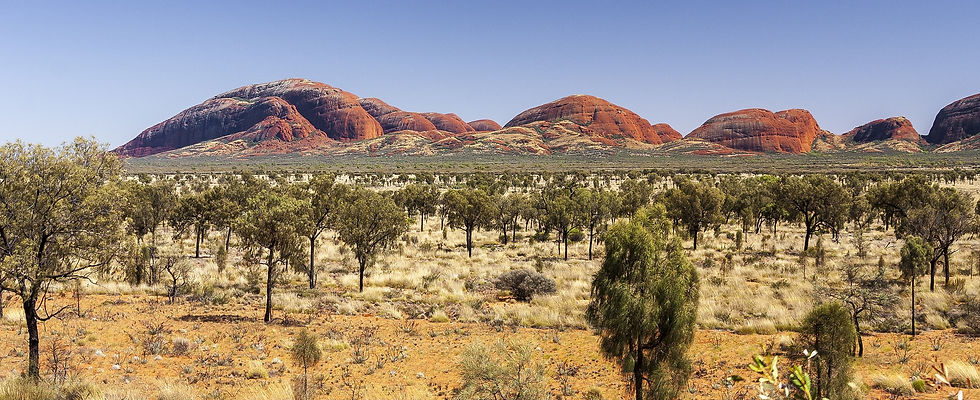
The interior of the continent, occupying most of its central and western breadth, is a vast expanse of red and ochre sand, gravel plains, and low, eroded hills. The Marraku Deserts are not uniform blankness; they are layered memory.
Dune-fields rise and fall in long, sinuous lines, marching slowly before prevailing winds. Between them lie gibber plains of bare stone, varnished by sun and time to a dark sheen. Flat-topped mesas crown the horizon in places, their sides carved by wind into fluted columns and caves. Dry riverbeds—tjarra—snake across the land, their depressions marking the courses of ancient waters and current songlines alike.
Rain here is rare and dramatic. When storms roll in from the northern seas, they appear first as low bands of dark cloud on the horizon. Lightning flickers; then long sheets of rain sweep across the land, turning dust into the briefest of streams and pans. Within days, ephemeral flowers burst from the soil, painting carpets of blue and gold around newly filled waterholes.
This is the realm of the Shifting Tribes of Marraku, of Dreamwalkers who read the faint hum of stone to find hidden springs, of Firekeepers who tend coals that have been carried from camp to camp for generations.
The Crystal Plains and Glassfields
To the east of the central deserts and in scattered belts elsewhere lie the Crystal Plains: fields where the ground is more quartz than soil. Broken crystals crunch underfoot like glass; slabs of translucent stone jut from the earth at angles like frozen waves.
Some of these plains are low and level, forming dazzling white pans that reflect the sky with painful intensity. Others tilt and roll, forming ridges of pure quartz that catch sunrise and sunset in kaleidoscopic refractions. In certain basins, ground-water interacts with silica to form opal-encrusted hollows, their walls shimmering with shifting color when lit.
At the heart of one such region lies the Glass Dune, a translucent mountain of fused sand and crystal. Lightning strikes here more often than anywhere else in Uatora. Each strike etches new filaments into the dune’s interior, visible as branching veins of darker glass. Marraku seers climb its flank at dawn to watch visions move within the dune—light-images of past and possible futures.
The Crystal Plains are not empty. Totemic camps and permanent stone circles mark routes between shade, water, and resource-sites. The Singers of Stone move among them, carving runes into select outcrops: not writing in the Krioslan sense, but mnemonic markers that hum when sunlight strikes them in certain ways.
The Nar’Kal Ranges and Stoneholds
In Uatora’s southeastern quadrant, the land swells into low but steep ranges of dark, metamorphic rock: the Nar’Kal Ranges. Here the Red Shelf has been thrust up and folded, exposing deeper stone.
Cliffs bear carved faces: gods, ancestors, dreaming beasts. Their eyes look out over canyons and river-gorges. Narrow ledges, stairways, and galleries have been hewn into the rock to allow people to reach and tend these carvings. Larger valleys hold amphitheatres—hollows where echo and resonance are unusually strong.
The Nar’Kal Stoneholds are settlements built into these cliffs, their chambers warmed by geothermal vents or cooled by underground streams. At dusk, Nar’Kal drummers take their places along ledges and strike hollow stones in complex rhythms. The mountains answer: echoes returning, altered but recognisable, like laughter passed between generations.
Below the ranges, foothills give way to forested valleys and, further east, to the coastal belts that feed the Mirawen Coast and other maritime realms.
The Mirawen Coast and Coral Seas
Along Uatora’s northeastern edge stretches a long curve of tropical coastline: broad, shallow bays backed by jungled hills, fronted by coral reefs and sandbars.
The Mirawen Coast is not one straight line but a map of inlets, mangrove estuaries, and barrier islands. Offshore, a great ribbon of reef runs almost unbroken, its outer face taking the full brunt of ocean swells, its inner lagoons calm and clear. Spirit whales move along this ribbon, breaching and singing in complex patterns that Dreamkin say are as much treaty as song.
Coastal settlements range from stilt-villages woven into mangrove roots to stone harbors built atop reef-rock. Canoes, outriggers, and larger sea-vessels crisscross the lagoons, their paddles and sails stitched with motifs of shells, waves, and the stylised eye of the Rain Whale, N’gurra.
Underwater, the Reef of Voices forms a cathedral of coral. In certain alignments of moonlight, the coral polyps glow faintly, and whale-song vibrating through the water seems to take on the timbre of human voices. Mirawen tide-priests descend with shell-horns to “converse” with the reef, emerging with omens for storms, migrations, and the health of Gaea’s dreams.
The Salt Mirrors and Moon Lakes
Scattered through Uatora’s interior depressions and southern lowlands lie salt lakes and pans: flat, pale expanses of crusted mineral that glimmer under sun and moon. Some are seasonal, filling with water only after rare rains and then evaporating; others are permanent, briny pools ringed with white.
On still nights, when wind has not ruffled their surfaces, these Salt Mirrors reflect the sky with uncanny precision. Stars appear more numerous in their depths than above. Lunara’s face hangs both overhead and below, perfectly aligned.
The Dreamkin say Yaluna, Silver Daughter of the Dreaming, has two eyes: one of sky, one of salt. To walk their shores at night is to walk along the edge of her vision. Certain salt lakes are so revered they are encircled by no-go zones. Only select Dreamwalkers enter their immediate vicinity for rites of memory and transformation.
In one southern basin, a ring of crater-lakes—Yaluna’s Ring—traces the outline of an ancient impact. Forested slopes fall steeply to round, deep waters stained cobalt by mineral content. Here, the Moon Serpent is said to coil below, eating nightmares that fall from the sky.
The Koru Isles and Ocean Arcs
To Uatora’s east and northeast, chains of islands extend into the greater ocean: volcanic peaks wreathed in cloud, coral atolls barely above sea-level, larger islands cloaked in rainforest and flanked by lagoons.
The Koru Isles are one such chain. Their name comes from the spiral frond of the fern, echoed in the spiral bays that notch their coasts and the spiral dances of their peoples. Volcanoes rise at their centres, some dormant and forested, others crowned with smoke. Rivers run down their flanks to meet the sea in waterfalls and estuaries rich with fish.
Further afield, the Vaelani Reef-Circle encloses a lagoon large enough to host whole flotillas. Beyond that, the Dream-Sea opens: an expanse of ocean that the Karru navigators say has its own songlines, running not along ground but along swell and star.
In Uatora, land ends; story does not.
Songlines, Dreaming, and the Breath of Stone:
In Haeslios, ley-lines are invisible currents that mages feel with training. In Uatora, they are roads of light and sound.
A songline is many things at once:
-
A path across country, linking waterholes, groves, caves, and stones.
-
A melody—sometimes a simple chant, sometimes a long, intricate sequence—that encodes that path.
-
A story of an ancestor or totemic being who walked that path in the Dreaming, shaping features as they went.
-
A conduit of geomantic force, pulsing gently with Gaea’s breath.
Dreamkin learn songlines as children. To travel, they do not say “we go east to the hills,” but “we follow Marraku’s left-hand footstep until the Stone Crow turns his head.” The song, sung in proper order, tells where to find water, which foods are safe, where taboo zones lie, what happened in those places, and which god or ancestor must be greeted.
At night, some songlines are visible as faint, milky streaks across the land, like the reflection of the Milky Way. Others can be heard only when one stands still in silence: a thin, constant hum just at the edge of hearing. Instruments carved from resonant wood or stone can “tune” to a songline and amplify it, allowing Dreamwalkers to diagnose its health.
A damaged songline—scarred by careless mining, desecrated by broken law, or distressed by distant cataclysm—flickers or drops in pitch. In the Time of Shattering, many nearly went dark. The Dreamkin’s collective memory of that trauma underlies their fierce protection of the Dreaming now.
To Dreamkin cosmology, Wandjari the Songmaker is Gaea’s original voice: the pulse that turned rock into memory. Marraku is the red father of earth and ancestors, shaping mountains. Yaluna is the silver daughter whose reflected gaze made salt mirror sky. Korrah is flame’s serpent; N’gurra, rain’s whale; Darra, shadow’s crow; Garrun, silent bone walking between.
These are not distant gods so much as ongoing processes. They exist as living songs that can sometimes take form: a serpent of fire curling along a ridgeline at dusk, a crow-shaped shadow landing where no bird is visible, a whale of cloud floating far above a desert where no sea has been for millennia.
The Dreamkin do not “worship” them; they remember and echo them. To tell Wandjari’s story at the right place is to help keep that place real.
Realms of Uatora — Seventeen Dreaming Polities:
The Lyceum hesitates to call anything in Uatora a kingdom. Power here is rarely centralised; authority is earned through song, stewardship, and remembered obligation. Still, for the Myth Keeper, it is useful to know the major confederations and spheres of influence.
The Tjarruna Confederation
At the heart of Uatora’s northern half, where several major songlines intersect, rises a broad, flat-topped mesa of reddish stone. Upon and within this mesa stands Tjarruna, the City of Song and Stone.
From a distance, Tjarruna looks like a natural table of rock ringed by cliffs. Up close, its surfaces reveal carvings: terraces cut into the sides, ramps that spiral up from base to rim, dwellings and meeting-halls hollowed into the vertical faces. On the summit, open plazas are set with stone circles and low, curved walls that catch and focus sound.
Here, the Eleven Song Elders meet. Each is chosen from a different Totemic Tribe and Dreaming Verse: Sky Serpent, Ember Kangaroo, Mirror Owl, Rain Whale, Stone Crow, Moon Serpent, Sand Lizard, Salt Flower, Cloud Emu, Glass Dolphin, and Fire Mantis. Together, they weave law through chorus rather than decree.
When matters of great consequence arise—disputes between tribal territories, violations of sacred sites, decisions about sharing Dreamcraft with outsiders—the Elders convene in the Songstone Amphitheatre, a natural bowl where voices carry with uncanny clarity. Each Elder sings their people’s understanding of the matter; others join, harmonise, or counter. When the land itself begins to hum in resonance, the decision is understood to have been reached.
The Tjarruna Confederation is not an empire. Tribes come and go in their adherence. Yet almost all recognise Tjarruna as a place where Dream-speakers gather, and its spiralled glyph symbol—concentric rings for earth, sky, and dream—marks treaties and shared spaces across Uatora.
The Shifting Tribes of Marraku
Across the central deserts, the Shifting Tribes of Marraku roam following the slow, circular patterns of water, game, and song.
They travel in small kin-groups that meet periodically at key waterholes and sites like the Glass Dune. At these gatherings, they exchange news, conduct marriage exchanges, and retell the longest Dream-Songs. Leadership is situational: the best navigator in one season, the most skilled storyteller in another, the clearest Dreamwalker during times of crisis.
Elder Jandari, called the Sand Whisperer, is first among equals: a woman whose hearing is said to be so keen she can tell the difference between wind at the surface and water deep below. Her counsel is sought when songlines dim or when Tjarruna must decide matters touching the interior.
Marraku culture prizes endurance, memory, and vision. Their languages are rich in words for different qualities of sand and heat. They view fixed architecture with mild suspicion; a camp that cannot be struck and carried is a camp that has forgotten it sits on Gaea’s skin, not in its bones.
The Mirawen Coast
Along the humid northeastern shores, the Mirawen Coast confederation binds together dozens of tide-clans and reef-villages.
Queen Aruka of the Tide-Shell Crown is more ritual figurehead than absolute ruler, but her lineage of tide-priestesses is old and respected. Crowned with a circlet of polished shell shaped like a rising wave, she presides over ceremonies at the Reef of Voices, offering thanks to N’gurra and Yaluna for calm seas and fruitful fisheries.
Mirawen law is drawn along tidal lines. Certain reefs may be fished on outgoing tide, others only on the turn, others not at all. Whaling is highly regulated; some pods of spirit whales are considered kin and must never be harmed. Canoes are blessed before long voyages, their hulls painted with patterns that mirror specific songlines at sea.
Mirawen craftspeople produce shell-inlaid drums tuned to the frequencies of whale-song and storm. Their music is layered, polyphonic, and often disorienting to outsiders. For the Dreamkin of the coast, it is simply how the world sounds.
The Nar’Kal Stoneholds
High in the southeastern ranges, Chieftain-Mason Uldra the Echohand governs by hammer and drum.
The Nar’Kal see stone not as inert material but as slow-moving speech. To carve a god-face into a cliff is not to “create” an image but to free a presence already sleeping there. Stone-carving is undertaken only after Dreamwalkers confirm the will of the rock; tools are consecrated with ash from Korrah’s fires and water from N’gurra’s springs.
The Echo Vaults—deep chambers where generations of laughter, song, and argument have been trapped in resonant stone—are Nar’Kal’s most treasured sites. To sit in them is to be surrounded by the voices of one’s forebears. Certain Echo Vaults are known to answer questions if addressed correctly; others are taboo, holding memories too raw to revisit.
Nar’Kal politics revolve around which faces are carved and awakened, which remain blank, which are shaved down when their stories are judged harmful. Uldra’s epithet, Echohand, comes from her rare talent: when she strikes a freshly carved mouth with her hammer, she can sometimes draw out not only a sound but a word.
The Karru Dream-Sea Alliance
Out beyond the Koru Isles, in the wide blue of the Dream-Sea, the Karru navigators have woven their own confederation.
They travel in long, sleek double-hulled canoes painted in swirling patterns that represent swell-lines and star paths. For them, islands are not separate lands but high points along ocean songlines: waystones in a moving medium. They hold that the sea itself is a vast dreaming being, slower-breathing than Gaea but kin.
The Karru Dream-Sea Alliance binds together dozens of canoe-clans and island communities from distant arcs and atolls. Their council meets on Vaelani Reef-Circle: a ring of coral enclosing a lagoon large enough to host hundreds of vessels. Decisions are made by drum and chant, with each clan adding a verse to the agreement.
Karru Dreamcraft leans heavily on sky and wave. They read the shape of clouds on the horizon, the feel of swell under hull, the behaviour of birds, the taste of wind. To them, Atlantean compasses and instruments are clever but crude; the world already tells you where you are, if you are willing to listen.
The Koru Spiral Isles
Closer to Uatora’s eastern coast, the Koru Spiral Isles form a tight volcanic archipelago. Here, green-cloaked peaks rise from sea like coiled ferns, their valleys rich with streams and gardens.
The Koru peoples align strongly with Wandjari and N’gurra. They plant in spirals and harvest in circles, singing as they move. Their houses are often semi-subterranean, built into slopes, with curved roofs that echo the fronds of ferns and the curls of waves.
Rather than formal kings, the Koru recognise Circle-Keepers: elders responsible for particular spirals of obligation—planting circles, tide circles, song circles. The Koru Spiral itself, an enormous labyrinth of carved earthworks and standing stones on the largest island, acts as their ceremonial capital. Walking its paths in correct order is a rite of passage and divination.
The Vaelani Reef-Circle
Though politically entwined with both the Karru Alliance and the Mirawen Coast, the Vaelani Reef-Circle is its own spirit-polity.
The Reef itself is a near-perfect ring of coral encircling a lagoon. On its inner rim, raised coral platforms and stilt-halls host seasonal gatherings: regatta-festivals, treaty-songs, marriage exchanges between island chains. On the outer rim, stone beacons burn whale-fat and resin at night, guiding travelers.
Vaelani people see themselves as gatekeepers between deep ocean and coast, binding the dreams of both. They maintain strict taboos on certain passages through the reef. To ignore their markers invites more than grounding—it invites the displeasure of N’gurra and Wandjari both.
The Glassheart Basin Custody
At Uatora’s centre lies a vast, shallow basin floored with crystal and salt: the Glassheart. In dry times, it is a field of cracked, glittering plates; after rare, heavy rains, it becomes a single enormous mirror.
Around its rim, several desert clans have formed the Glassheart Custody: a guardianship rather than a state. They have sworn, in Tjarruna’s Amphitheatre, to keep heavy structures and mining away from the basin, to give warning when storms approach that will fill it, and to preside over rites held on its shores.
The Glassheart is where Dreamwalkers seeking profound change come. To spend a night alone on its surface, with stars above and below and songlines humming beneath the salt, is to risk emerging no longer quite the same.
The Rain Whale Shoals
South of the Mirawen Coast, off a section of rugged, wave-pounded shore, lies a series of submerged ridges and sandbanks that break the open ocean’s force and create rich feeding grounds. The Rain Whale Shoals are both ecological and spiritual hub.
Whale Priests of N’gurra maintain stone markers and offering-sites on the few small islets that rise here. They interpret the timing of whale migrations, the frequency and tone of whale-song, and the interplay of rainfronts with whale-breath spouts as messages from the Dreaming.
Though no one “rules” the Shoals, the Whale Priests’ decisions carry immense weight. When they declare that whaling must cease for a season, clans obey—even if hunger looms—because they remember the Time of Shattering, when whales screamed in songlines as the Second Moon fell.
The Stone Crow Highlands
To the west of Tjarruna, low ranges and mesas cut by deep ravines form the Stone Crow Highlands. Dark, weathered basalt columns rise here in stacks, looking from a distance like flocks of crows perched on ridges.
The Stone Crow tribes honour Darra, the Shadow Crow, as their primary totem. Trickery, in their philosophy, is not cruelty but a way of loosening rigid thinking. They are consummate scouts and messengers, able to vanish into ravines and reappear days later far across country along hidden songline branches.
Their governance is fluid, much like their totem. A Circle of Feathers—a gathering of respected tricksters, judges, and Dreamwalkers—convenes when needed, then dissolves. Their influence as mediators and secret-keepers extends deep into Marraku and far toward the coast.
The Wattlebark Greenways
In the more temperate southeastern quadrant of Uatora, between the Nar’Kal Ranges and the colder southern seas, pockets of forest thrive: stands of tall, golden-flowered trees with peeling bark and deep roots reaching for groundwater.
These Wattlebark Greenways are stewarded by tribes whose Dreaming centres on the Sky Serpent weaving through branches and clouds. They build few permanent structures, preferring camps that move with flowering and fruiting cycles. Their Dreamcraft excels in plant-song: coaxing saplings to grow in certain shapes, singing wounds closed on tree and person alike.
Because the Greenways run perpendicular to several major songlines, they serve as resting-places and sanctuaries for travelers. Hospitality here is sacred; to violate it is to offend Wandjari and Marraku at once.
The Black Dune Brotherhood
In Uatora’s far west lie the Black Dunes: fields of dark, iron-rich sand that absorb heat by day and radiate it by night. Few things grow here; waterholes are rare and fiercely protected.
The Black Dune Brotherhood is a loose but fiercely devoted alliance of clans who consider themselves guardians of the continent’s harshest face. They patrol the margins of the Black Dunes, ensuring no one unprepared wanders too far in, and that no one attempts to exploit the dunes’ mineral wealth in ways that would harm songlines below.
They align strongly with Garrun, Bone Walker. Brotherhood initiates undergo rites that bring them close to death in the dunes; those who return are said never again to fear silence.
The Sky Serpent Escarpments
Along parts of Uatora’s northern and eastern coasts, long escarpments drop sharply from plateau to sea. In places, waterfalls pour over their lips; in others, cliff faces are bare, painted ochre and white with ancient figures of coiled serpents.
These Sky Serpent Escarpments are liminal spaces: neither fully land nor sea, neither easily accessible from above nor below. The tribes that tend them specialise in cliff-climbing, rope-bridges, and wind-reading. Their initiation trials include walking narrow ledges in high wind while singing specific Dream-Songs.
The Escarpment peoples often act as intermediaries between interior and coast. They are adept at reading both river-speech and wave-speech—and at reminding others that the Sky Serpent’s body is both cloud and cliff.
The Moonmirror Desert Circles
In the southern interior, where impact scars and salt pans cluster, several tribal circles have formed around particularly potent Moon Mirrors: salt lakes whose reflections are so perfect that one cannot look into them without vertigo.
The Moonmirror Circles see Yaluna not just as a distant silver daughter but as a presence whose tears are underfoot. They keep strict calendars of lunations, eclipses, and the rare events when Lunara passes directly above certain lakes, causing light to refract in strange ways.
Their Dreamcraft focuses on reflection and pathfinding. Many Dreamwalkers from other realms travel to Moonmirror circles when seeking to face parts of themselves they have long avoided. Garrun, too, walks closely here.
The Emberstep Range Clans
In Uatora’s northwestern corner, an arm of the continent has been uplifted and broken, forming a low but active volcanic belt: the Emberstep Range. Here, small cones, fumaroles, and hot springs dot a landscape that otherwise resembles Marraku: red soil, sparse vegetation, big sky.
The Emberstep Clans blend Korrah’s fire with Marraku’s earth. They tend sacred fire-pits heated by geothermal vents, maintain pathways across cooled lava fields, and watch for signs of impending eruptions. When the ground trembles, they listen, placing hands and ears to stone until they can “hear” whether the quake is anger, laughter, or simple stretching.
Their settlements are small and mobile, for they know the land they love can turn fluid without much warning.
The Selkiri Cloud Plateau
On the eastern side of the Nar’Kal Ranges, a high plateau catches moist air from the Mirawen seas. Cloudforest blankets its edges; grasslands and shallow lakes fill its interior.
The Selkiri clans who inhabit this plateau move with the clouds. They follow seasonal mists, grazing semi-domesticated dream-kangaroos and rain-goats, planting gardens where fog condenses most thickly. Their totems are often birds that ride thermal updrafts—kites, hawks, and an occasional Mirror Owl, whose feathers are said to reflect stars.
The Selkiri share kin-ties with Nar’Kal Stoneholds, the Wattlebark Greenways, and even Koru Isles. As such, they are often go-betweens in matters that cross mountain, forest, and sea.
Yaluna’s Ring Stewardship
Finally, around the ring of crater-lakes in the south, a council of tribes has taken on a specific vow: to maintain the balance of that damaged but powerful place.
They call themselves simply the Ring Stewards. Their law-bindings are carved not into stone but into the shoreline: patterns of arranged pebbles that are periodically erased and rewritten, a reminder that even solemn vows must be reviewed.
The Ring Stewards monitor unusual dreams among their people—prophetic nightmares are considered possible whispers from the Moon Serpent below. When certain thresholds of shared dream are met, they send word to Tjarruna and, through it, to the Temple of the Elements in far Eagren.
The Ring is where the Legend of the Third Moon is strongest. The Dreamkin do not believe a physical third moon will rise; rather, they speak of a third eye opening—some conjunction of sky, salt, and dream that will change how reality is sung.
Dreaming Gods and Living Law:
The pantheon of Uatora is less a family tree and more a cycle of verses.
Wandjari, the Great Songmaker, is the first chord: a ripple of sound expanding outward, vibrating stone, water, and air into wakefulness. When Dreamkin paint his symbol—a concentric ring of ripples—they are not depicting a person but a process: the way one act of creation begets another.
Marraku, the Red Father, shapes earth and ancestors. His mark is the handprint within a spiral: an explicit reminder that every touch on the land becomes part of its memory. When elders place their handprints on cave walls, they are “signing” their understanding of Marraku’s part of the Dreaming.
Yaluna, the Silver Daughter, rules the moon and reflection. Her symbol—a crescent above twin eyes—hints at her dual sight: sky and salt, dream and waking. In Uatora, Lunara is the visible face of Yaluna; Selas, the so-called second moon, is understood now as her reflection in the Dreaming after it fell. Talk of a “Third Moon” among Dreamkin is almost always metaphor—a future depth of reflection, not a literal celestial body.
Korrah, the Fire Serpent, coils through campfires and lightning strikes. When flame moves unpredictably in Uatora, people often say “Korrah is dancing” rather than “the fire is out of control.” Renewal through burning—of grasslands, of fallen timber, even of old story-patterns—belongs to Korrah.
N’gurra, the Rain Whale, embodies water and emotion. Her silhouette beneath falling lines of rain appears in rock art from Mirawen to Moonmirror. When long-dry creekbeds suddenly flow after a remote storm, Dreamkin say N’gurra has rolled in her sleep.
Darra, the Shadow Crow, perches on the line between spirit and trickery. His feather crossed by footprints motif reminds walkers that laughter can be medicine and deceit can sometimes serve deeper truths. To invoke Darra is to invite complication; to ignore him entirely is to invite stagnation.
Garrun, the Bone Walker, attends death and transformation. His spiral skull surrounded by stars is not fearsome to Uatoran eyes; it is a sign of continuity. Bodies return to earth; songs persist; Garrun merely ushers the transition.
These beings are not obeyed as distant rulers. They are consulted, argued with, teased. Their stories encode law: who may hunt which animal when, who must tend which waterhole, how to behave in places where the land is thin and dreams close.
Breaking these laws is not just a social offence; it is cosmological vandalism. The Firekeepers of Korrah, the Whale Priests of N’gurra, the Trickster’s Path adepts of Darra, and the Dreamwalkers of Wandjari all exist to repair such damage when they can—and to warn when they cannot.
Dreamcraft, Guilds, and Living Aether:
Uatoran magic—Dreamcraft—is the art of shaping reality by singing in tune with it.
A Dreamcraft working begins not with an incantation but with listening. Dreamwalkers sit, breathe, and let their minds sink into the ambient songline hum. Only when they have found the right key do they begin to sing, chant, stamp, or dance.
A healing Dreamcraft might involve a chorus of kin singing a person’s Dreaming Verse while painting luminescent clay sigils on their skin. A weather-working could be a line of dancers tracing a storm’s remembered path across a dry creekbed, calling it back. A curse, when they are deemed necessary, is often no more than an omission: a name removed from a song so thoroughly that the land forgets a person’s right to be there.
Truth is crucial. An untrue song—one that claims a Dreaming track where it does not exist, or attributes a story to the wrong place—warps the world. Such warps may be small: a track that leads travelers astray, a waterhole that refuses to fill. Or they may be catastrophic: a songline twisting away from its normal route, leaving entire communities dreamless.
The Dreamwalkers are the most respected and feared of Uatoran orders. They walk minds as easily as they walk country, entering dreams to heal trauma, confront lies, or retrieve lost fragments of song. Their journeys are dangerous; Garrun always walks a little ahead of them in the dark.
The Singers of Stone, often associated with Nar’Kal and Crystal Plains, carve runes and figures that vibrate faintly with stored melody. When sunlight or firelight touches them, they hum, releasing parts of the song. These are not “spells” in the Atlantean sense but memory-nodes: they help anchor Dreaming in place.
The Firekeepers of Korrah maintain sacred fires at key hearths and stones. Some have burned, with careful tending, longer than the Lyceum has existed. They travel, carrying coals from these fires to re-ignite others, binding camps and clans into the same chain.
The Whale Priests of N’gurra interpret whale-song patterns as complex as any script. Their floating ceremonies atop carved canoes act as both divination and diplomacy. More than one inter-continental voyage from Jaiphora or Trikoya has passed into or out of Uatora’s story only because a Whale Priest decreed that it be so.
The Trickster’s Path is not a formal guild but a tendency in certain individuals: those who feel Darra’s feather tickle their thoughts. They wander, appearing where songlines grow rigid, where leadership calcifies, where law forgets laughter. Their mischiefs can be mean or merciful; the land’s reaction is often the final judge.
Aethertech in Uatora is gentle. Crystal chimes hang where songlines cross, their tones changing slightly with the health of the line. Instruments carved from stone store sound as light, their surfaces glowing faintly during performances and dimming as the song is “used up.” Stone golems and guardians, where they exist, are slow, patient beings whose primary task is to remember.
Atlantean devices, when they occasionally wash up from ruined outposts on Jaiphora or Trikoya, are treated with great caution. The Dreamkin recognise their cleverness but consider them dangerous in their indifference to place. Any technology not rooted in Dreaming is, to them, a machine that does not know whose house it is in.
Deep Time — Uatora’s Ages:
The Dreamkin do not count years the way the Lyceum does. Their history is sequenced in songs, each verse a period, each refrain a catastrophe or renewal. Translating this into the Lyceum’s chronology is imperfect but possible.
In the Time of Singing Stone, before any date that can be comfortably expressed in BGF, Uatora’s leys glowed bright and constant. The Dreamkin say their ancestors were not born from wombs but from stone eggs: hollow nodules in cliffs and plains that cracked when Wandjari’s song passed through. Every egg hatched with a different totemic imprint, giving rise to hundreds of tribes at once.
In the Age of Moons, roughly 40,000–35,000 BGF, the sky held Lunara and her sibling Selas. Yaluna’s eyes, the Dreamkin say, watched from both sides of the world. Moontides were more complex then; coral growth surged; salt lakes swelled and receded in patterns no one now can fully reconstruct. It was during this era that the first songstones were carved: fixed nodes to help remember which moon-phase called which tide, which dream, which obligation.
The Time of Shattering, around 34,000–28,000 BGF, began when Selas fell. Fragments of the Second Moon struck many parts of Gaea, but Uatora took several heavy blows. Craters punched into the Red Shelf; shockwaves rattled leys. Songlines stuttered, broke, or tangled. Some Dreamkin tribes were cut off from their traditional routes not by physical barriers but by dream-storms: zones where sleep became dangerous or impossible.
It was in this crisis that the Dreamwalkers first emerged in their present form: shamans stepping into the broken dreamspace to splice songs together, to bind fractures with chant and dance. The Tjarruna mesa—then just a prominent rock—became a gathering point for such healers. The Stone Crow tribes say Darra laughed through the whole thing, forcing everyone to get creative.
The Age of Silence, roughly 27,000–0 BGF, saw the Great Freeze roll over Gaea. In Uatora, ice sheets did not dominate, but temperatures dropped, rains shifted, seas retreated and later surged. The dreamlines dimmed: not extinguished, but reduced to embers.
In response, the Dreamkin turned inward. Many songlines were walked less frequently to avoid overtaxing them; great Dream-Songs were cut up and shared, so no single mind held too much. Tjarruna’s Confederation solidified, not as a government, but as a fire-circle around which many world-fragments could be told and retold until the Freeze passed.
Now, in the Reawakening, the songlines are brightening again. New verses are being added—carefully—to old songs. Dreamwalkers report seeing colours in the Dreaming they have no words for yet. The Dreamkin’s greatest fear is not Atlantean conquest or Krioslan law, but careless stories from outside—so loud and out of tune they might distort the Dream itself.
The Legend of the Third Moon belongs to this era. To the Lyceum ear, it sounds apocalyptic: “When the Third Moon rises, the Dreaming will awaken, and gods beneath the red earth will sing Gaea anew.” To the Dreamkin, it is both promise and warning. The “Third Moon” is the next level of reflection, the moment Gaea dreams herself aware of dreaming. Whether that means transcendence or rupture depends, they say, on how well everyone—Dreamkin and foreigners alike—has learned to listen.
Using Uatora in Your Tales:
Running stories in Uatora is not like running stories anywhere else. The land is not a backdrop but an active collaborator.
If you set adventures in the Marraku Deserts, let thirst and distance matter, but also let songlines save lost travelers when they finally shut up long enough to hear a faint hum in the ground. Let glass dunes show visions that may or may not be true, and let the players argue over which is which.
Along the Mirawen Coast and in the Karru Dream-Sea, give the ocean a voice. Let whales sing warnings about distant storms. Let reefs respond to song, opening safe passages or closing them. Make navigation a matter of relationship, not just dice.
In the Nar’Kal Stoneholds, let echoes carry secrets. Have a careless remark in a cliff-hall be repeated back at the worst possible time, not because of spies but because the stone itself thought it was important. Let carved faces weep condensation when stories go wrong.
On the Salt Mirrors and at Yaluna’s Ring, let reflection be literal and metaphorical. A character might see, in the lake beneath their feet, not their own face but the face they still could become. Garrun is always nearby there; so is the Moon Serpent, ready to eat nightmares if players are brave enough to offer them.
The single most important tool you have in Uatora is consequence of story. Words said in anger may scar a songline. A promise chanted with sincerity might become binding law for an entire region. Outsiders who come trying to impose foreign maps and measures will find them sliding off; paths drawn only on paper, not in song, have a way of wandering.
Let the Dreamkin remain themselves. They are not quaint primitives; they are custodians of a continent-sized memory system that has survived moonfalls and ice ages. They can be generous, fierce, wry, or exasperated—but they are never, ever impressed by someone who thinks a scroll is more real than a mountain.
As Archivist Vayne wrote after his only visit to Tjarruna:
“Uatora does not ask whether you understand.
It asks whether you are listening.
Those who do not can still walk upon it—
but they leave no tracks the land cares to remember.”