


How Myths of Gaea Answers the Call for New D&D Campaign Worlds

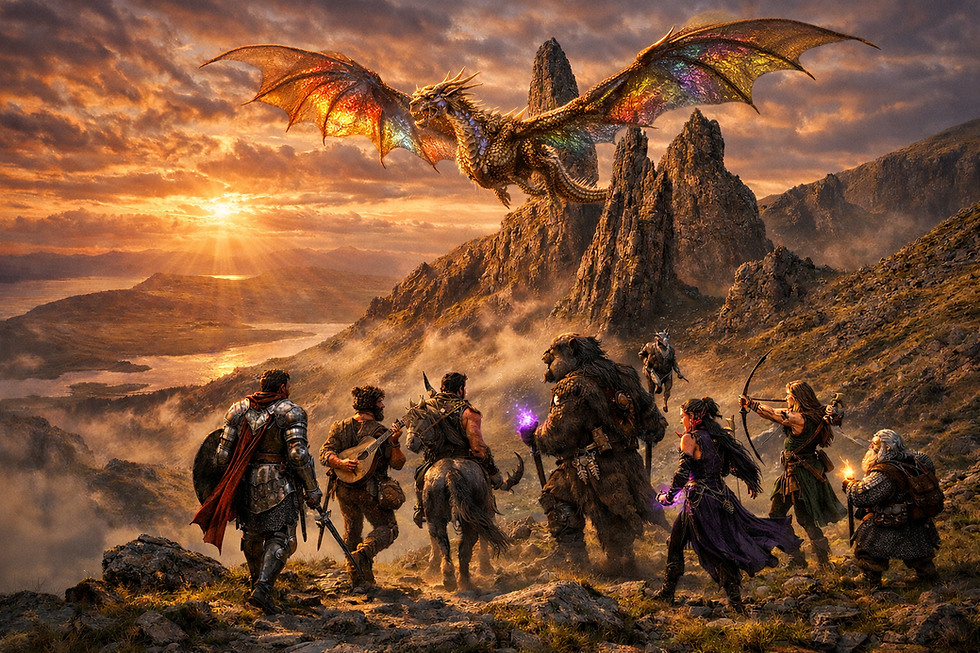
Since its debut in the 1970s, Dungeons & Dragons has been more than just a game -- it's been a gateway into the collective imagination. For generations of players, it has offered a stage upon which to conjure empires, battle unspeakable evils, forge bonds of fellowship, and explore worlds vast beyond comprehension. From the snow-capped peaks of Icewind Dale to the labyrinthine tunnels of the underdark, from moonlit elven glades to the molten chaos of the elemental planes, D&D has invited adventurers to live a thousand lives in lands touched by magic, mystery, and myth.
But now, after decade of traversing these stories realms, a quiet murmur has begun to rise among players and Dungeon Master alike -- one that echoes with growing clarity at convention tables, online forums, livestreams, and local game nights. It's a question that doesn't challenge the legacy of D&D, but rather honors it by asking how it might evolve: What's next?
This question isn't born of fatigue or cynicism. On the contrary, it comes from a place of deep reverence -- from those who have walked the Sword Coast a dozen times, who know the political intricacies of Waterdeep better than their own cities, and who have memorized the names of dragons, deities, and demigods stretching across editions. These are storytellers and dreamers who love the game, and who now long not to replace its worlds, but to rediscover the wonder they first felt when everything was unknown.
That same yearning forms the core of a powerful and timely reflection published recently by DungeonsAndDragonsFan.com, titled "Why D&D Desperately Needs a New Campaign Setting." The article gives voice to what many in the tabletop roleplaying community have been sensing: that the current D&D universe -- rich though it is -- has reached a saturation point. The maps are drawn. The legends are chronicled. And while there's comfort in familiarity, there's also a certain creative gravity that begins to weigh down the thrill of discovery.
And so, we find ourselves at a crossroads -- a moment in the game's evolution that calls not for erasure of the past, but for the emergence of something mythically new.
Enter Myths of Gaea: an evocative, storytelling-forward campaign setting crafted by RPG Storytelling. Gaea isn't just another dot on the multiverse map -- it's a canvas of legend, a world where gods persist only if they are remembered, where history is carried in song and shadow rather than written stone. In Gaea, stories are not preserved -- they are lived. And it may be exactly the world that players and DMs have been unconsciously waiting for: a place not to merely visit, but to co-create.
Below, we'll explore why Gaea speaks so powerfully to this moment in tabletop history -- and how it could offer not just a new setting, but a renewed sense of wonder.

The Weight of Familiar Worlds
To truly grasp the desire for something new, we have to confront an uncomfortable truth about the very settings that built the found of modern tabletop fantasy: the familiar can, over time, become a cage.
The original article on DungeonsAndDragonsFan.com articulates this beautifully. It argues that while settings like the Forgotten Realms, Greyhawk, and Dragonlance have shaped generations of adventure, they now carry with them the burdens of age. These worlds -- once vibrant with the unknown -- have become so comprehensively charted, so intricately detailed, that the wonder they once evoked now risks being stifled under the weight of their own legacy.
What were once wide-open frontiers for creativity have, in many cases, become well-lit museums. Ever town has a name, every artifact a backstory, every deity a political agenda. Mystery has been replaced with metadata. Discovery has been supplanted by documentation.
For new players, this can be daunting. To step into a campaign set in Faerûn or Krynn is to step into a world already buzzing with expectation. You're not just learning how to play D&D -- you're also navigating decades of canon. It's like joining a beloved TV series in its 15th season and being expected to understand all the relationships, alliances, betrayals, and callbacks from episodes you've never seen.
But for veteran players and Dungeon Masters, the issue stikes a different chord. They've been there. They've fought in the War of the Lance. They've uncovered the secrets of the Underdark. They've spoken with gods and watched cities rise and fall. And while that history is rich, it also casts a long shadow. Where, in these vast and storied worlds, is there room to tell new stories that aren't already echoes of old ones?
Campaign settings were once playgrounds for invention. They were spaces where no one knew what lurked beyond the next hill, or what forces slept beneath the mountains. Now, they can feel like someone else's novel -- beautifully written, yes, but already complete. They story has been told. The lore is canonized. The sandbox is full of footprints.
And so, instead of stepping into a world that responds to their imaginations, players often find themselves playing roles in narratives that have already been shaped, structured, and settled. Their characters risk becoming actors in someone else's legend, rather than authors of their own.
This is the existential dilemma facing many DMs and players today. It's not that the classic worlds are broken -- they're beloved, iconic, and enduring for good reason. But when creativity feels confined by canon, when discovery is dulled by familiarity, it's only natural to crave a setting that breathes again. A setting that listens. A setting that waits to be remembered. That's where the hunger for something new begins -- not from discontent, but from a yearning to reclaim the sense of discovery that first drew us to the table. It's not about abandoning the old. It's about making space for the next myth to be born.

Myths of Gaea: A Living World Remembered
This is where Myths of Gaea steps into the conversation -- not merely as another destination on the fantasy map, but as a complete reimagining of what a campaign setting can be. It doesn't just propose a new land to explore; it proposes a new relationship between the world and its players.
In most traditional settings, the world exists like a museum exhibit: fully assembled, labeled, and neatly cataloged. History is fixed, lore is immutable, and the deities are more or less unchanged figures presiding over well-established domains. You enter these worlds like visitors arriving late to a story that's already been told.
But Gaea is different. Gaea breathes.
It is a world that does not archive its past in dusty libraries or timeless codices, but in the soft fragility of memory. What is know of Gaea is not what has been written down, but what has been passed from mouth to mouth, from hearth to campfire, from ancestor to child. It is a world held together not by facts, but by belief. Its legends are not static accounts but living things -- shifting, contradicting, reshaping themselves with every new retelling.
In Gaea, truth is not absolute. It bends with the storyteller. It dances with the song. The very fabric of history is fluid, shaped not by what happened, but by what people remember. And that, more than any rulebook or map, is what defines this world.
What emerges from this philosophy is a setting where your character's journey is not just an isolated thread -- it's a stitch in the world's mythic tapestry. Every decision, every sacrifice, every whispered name has the potential to ripple forward and back through Gaea's memory. Your deeds don't fade when the session ends; they echo, refracted through the stories of others, shaped by how they are told and retold.
A fallen knight might become a cautionary tale in one region, a martyr in another, and a divine patron in a third -- all depending on who carries their name forward. An ordinary adventurer, once lost to the wilds, may someday be remembered as a titan-slayer, a god-whisperer, or the first in a new bloodline of kings. Gaea does not discriminate between fact and fable. In its eyes, both are real -- because both are believed.
This approach doesn't just enrich gameplay. It transforms it.
Whereas many campaigns place characters into a setting that is largely indifferent to their passage, Myths of Gaea makes remembrance itself the engine of worldbuilding. Your story doesn't just unfold within the world -- it changes the world. You're not an observer of a prewritten history. You're a co-author of an unfolding mythology.
Even the divine pantheons of Gaea are bound by this principle. Gods do not endure simply because they are all-powerful or omnipresent -- they endure because someone believes in them. A forgotten deity does not rage in exile or plot a return; they simply vanish, erased not by war, but by the silence that follows. Just as belief can summon the sacred, its absence can dissolve it.
In this way, the metaphysical laws of Gaea mirror the truths of real-world mythology. Civilizations rise and fall not just through conquest and collapse, but through stories -- through what is remembered, revered, and retold. In echoing that human instinct, Gaea becomes more than a setting. It becomes a mythopoetic framework that honors the storyteller in every player and Dungeon Master.
There's a quiet power in that. A freedom.
No longer does a DM need to worry about fitting their campaign into the rigid confines of continuity. No longer must players worry whether their backstory aligns with a complicated world timeline. Gaea gives permission to create, to invent, to remember -- and in doing so, to leave a mark.
It is a world that does not ask for credentials or canon knowledge. It asks only that you speak, that you imagine, and that you let your story take root in the soil of legend. Because in Gaea, what is remembered matters. And what matters can become real.

Storytelling That Emerges from the Table
For Dungeon Masters, the world of Myths of Gaea offers more than just a new setting -- it offers a liberation. Gone are the anxieties of lore accuracy, the pressure to weave campaign through decades of rigid canon, or the feeling that every improvisation must be cross-checked against a preexisting timeline. In Gaea, there is no checklist to fulfill. There is only the moment you share wit your players -- and the myth that moment might become.
The responsibility of creation no longer sits solely on the shoulders of the DM as a historian or archivist. Instead, the role becomes something far more rewarding: that of a living storyteller. You're not curating a museum exhibit; you're helping to birth a culture, an entire worldview, as it emerges in real time. The cultures that form, the beliefs that persist, the rituals that arise -- these aren't imported from a lorebook. They are grown, session by session, conversation by conversation, shaped by the choices of the players and the spirit of the table.
Religions in Gaea don't need formal pantheon charts. They are not frozen theological systems lifted from a sourcebook. They evolve from prayer, fear, hope, and humor. A peasant's whispered superstition may one day be codified into doctrine. A player's in-character eulogy might become the basis for a regional death rite. And a forgotten idol, once joked about around the fie, could ascend to divinity if enough voices believe it into being.
This approach empowers not only Dungeon Masters but players as well. It shifts the balance from performance to participation. Curiosity becomes more valuable than correctness. Improvisation takes precedence over encyclopedic knowledge. What matters most is not whether a detail aligns with lor -- it's whether it resonates in the moment, whether it feels true to the people telling the story.
The result is something profoundly human.
Campaigns in Myths of Gaea often begin with no more than a breath, a gesture, a suggestion. A phrase like "Once, it is said..." is enough to set the mythic machinery in motion. From that seed, a campaign grows organically. The ruined tower on the horizon may not have an entry in a guidebook, but someone remembers what happened there -- at least, they think they do. The People of the nearest village may offer tales: some tragic, some contradictory, all shaped by the biases of those who pass them on. The truth, if it exists, is not handed to the players. It's something they must piece together, reinterpret, or even invent entirely.
And perhaps that's the most radical gift Gaea offers: the idea that truth is something made together.
When players explore, they are not simply uncovering what has already been placed for them. They are helping to define it. They are shaping not just their own story arcs, but the broader history and mythology of the world around them. Every in-character rumor, every bardic song, every belief uttered in fear or faith becomes another thread in the evolving tapestry of the setting.
This changes the way players engage with the game. Instead of following a predetermined path or unraveling secrets set long before they arrive, they become architects of meaning. They decide what matters. They choose what will be remembered.
It also transforms the act of Dungeon Mastering into something sacred. No longer are you bound to recite established facts or deliver exposition like a tour guide. You become a co-creator, a listener as much as a narrator. The joy of running the game becomes the joy of discovering the world alongside your players -- not revealing it, but building it in tandem.
In doing so, Myths of Gaea returns tabletop storytelling to its roots: a circle of friends, gathered around the glow of imagination, speaking a world into existence one word at a time. It strips away the burden of perfect preparation and replaces it with something more powerful -- permission. Permission to invent. To adapt. To mythologize. To let go of control and trust in the collective narrative instinct of the group.
This isn't just a shift in setting. It's a shift in philosophy. It reminds us that at its heart, Dungeons & Dragons was never about remembering all the lore. It was about creating it. And in Gaea, that creation is not just allowed -- it is revered.

A World That Values Imagination Over Precedent
There's something undeniably primal -- and profoundly human -- about the way Myths of Gaea approaches knowledge, memory, and truth. In Gaea, stories are not anchored in ink and parchment. They are not safeguarded by ancient tomes or frozen in historical treatises. Instead, they are alive. They move. They breathe.
In this way, Gaea doesn't simply borrow from ancients oral traditions; it honors them. It adopts the worldview that defined how real-world civilizations once understood their pasts and made sense of their place in the cosmos. In those cultures, stories weren't things you consulted. They were things you told. They weren't recorded so much as remembered. Repeated. Embellished. Reimagined.
Truth, in such worlds, wasn't a singular, objective certainty. It was a shared act of remembering -- a communal ritual, shaped as much by the needs of the present as the details of the past. Gaea brings that framework into the TTRPG space, not as a nostalgic flourish, but as a foundational mechanic.
Here, civilizations don't simply fall to war or ruin. They can dissolve from collective memory. When no one recalls a kingdom, it becomes as if it never existed -- its temples buried not just beneath earth and vine, but beneath the silence of forgetting. Gods, too,are vulnerable to erasure. A once-revered deity can fade from reality, not because they are slain or sealed away, but because the last believer stopped whispering their name. In Gaea, belief is the bedrock of being.
What this creates in a world that resists uniformity. It invites contradiction. It flourishes in tension.
Two travelers from opposite ends of the continent might recount the same historical event in radically different ways. One may speak of a celestial war that shattered the sky; another insists it was merely a symbolic tale told to explain the erratic seasons. Which version is true? In Gaea, the question misses the point. Both are real because both are believed.
This approach gives rise to a richly textured setting -- a world where history is a matter of perspective, and perspective itself is sacred. It challenges players to engage not just with the "what" of the world, but with the why. Why is this version remembered here, and another there? Why do some believe while others forget? What does that say about the people, the land, the legacy?
It also invites characters to play a more active role in shaping the truths of the world. As adventurers, they don't just act within the confines of myth -- they have the power to create it. When they perform a great deed, its impact may be less about what happened and more about how it is retold. A battle becomes a legend not through scale, but through memory. A miracle becomes divine not through proof, but through repetition.
This elevates the narrative agency of players in ways few campaign settings attempt. Gaea is not just reactive; it's responsive. It listens. It absorbs. It allows the imaginations around the table to reshape the contours of the setting itself.
The result is a world that is never finished, never fixed. It evolves in the telling, and that evolution is not a bug -- it is the very design. In this, Myths of Gaea respects not only the bravery and cunning of its characters, but the creativity, spontaneity, and collaboration of the players behind them.
It doesn't reward knowledge of canon -- it rewards the courage to invent. To speak a story into being. To let belief shape reality. And that, more than any rule or map, is what makes it feel like a world worth remembering.
Responding to the Moment
The article published on DungeonsAndDragonsFan.com was more than timely -- it was perceptive. It captured something many long-time players have felt but haven't always put into words: Dungeons & Dragons is changing. Or rather, the people gathering around the table are.
Gone are the days when a campaign's primary thrill came from mapping dungeons and vanquishing monster. Those elements remain beloved, of course -- they always will -- but the heart of the hobby is shifting. Today, more than ever, players arrive not just with character sheets and dice, but with questions, ideas, and personal stakes. They're not only seeking victories; they're seeking meaning. They want stories that leave a mark, characters who evolve in profound ways, and worlds that responds to their choices with emotional and narrative.
This isn't just a matter of storytelling preference -- it's part of a wider cultural movement in gaming. Roleplaying today is as much about expression as it is about mechanics. Players want to co-author tales that reflect their values, their curiosities, their need to be surprised, delighted, and moved. They want stories that feel as if they couldn't have happened without them.
Myths of Gaea was built for this moment. In every way, it embraces the idea that the world isn't a fixed backdrop, but a living story that reshapes itself through memory, belief, and imagination. It doesn't ask players to fit themselves into predetermined plotlines. It invites them to make their mark are the mythos itself.
For Dungeon Masters, the shift is equally empowering. Rather than serving as custodians of canonical truth, the DMs in Gaea become guides, interpreters, and fellow mythmakers. They respond to what the players offer. They build alongside their table, crafting rituals, histories, and divine mysteries not from pages of reference material but from the unfolding rhythms of the campaign itself. In Gaea, no two stories are alike -- because no two groups remember the world in the same way.
What makes this approach especially compelling is that it doesn't require players or DMs to abandon the touchstones they've always loved about D&D. The familiar elements are all still here. There are dragons to challenge, ruins to explore, ancient beings awakening beneath forgotten mountains. The architecture of fantasy remains standing.
But its resonance has changed.
In Myths of Gaea, the monstrous is no longer just an obstacle -- it's part of an evolving myth. A dragon is not merely a creature to be slain, but a symbol that shifts depending on how it's remembered. A ruin may not have a written history, but it may be whispered about in half-remembered songs, its meaning altered with each retelling. The familiar takes on new life not because the rules have changed,but because the context has. Because the telling is different.
And that's the key. Myths of Gaea doesn't reject tradition. It transforms it. It recognizes the enduring power of archetypes and tropes,then places them into a world where their meaning is constantly in flux -- where their relevance is shaped by how people feel about them, not just how they're described in a sourcebook.
In this way, Gaea doesn't just respond to the moment. It belongs to it.
It's a setting that meets modern players where they are -- curious, imaginative, emotionally invested -- and gives them the freedom to explore a fantasy world that remembers what they contribute. A world that grows because of their stories, not in spite of them.

Making Room for Wonder Again
If Myths of Gaea offers any singular gift to the modern tabletop experience, it is this: the return of wonder.
In recent years, as tabletop roleplaying games have surged in popularity, the spaces they create have grown increasingly well-lit. Worlds that once invited exploration have become exhaustively documented. Maps are complete. Histories are footnoted. The pantheons,politics, and power structures of fantasy settings are readily available at the click of a mouse or the turn of a hardcover page. For many players, particularly those immersed in long-standing franchises, the mystery is gone before the game even begins.
Today's adventures often walk into their fist session already burdened with knowledge. They know the god's names, their domains, their rivalries. They can quote the lineage of noble houses, the political motives of major factions, the significance of obscure battlefields. They've watched hours of livestreamed campaigns, absorbed endless fan theories, and perhaps even devoured pages of wiki entries long before rolling initiative for the first time.
While this wealth of information can deepen appreciation, it also changes the nature of play. Exploration gives way to expectation. Discovery becomes validation of what the player already suspects. And while some enjoy the familiarity, others find themselves yearning for something that feels new again.
Myths of Gaea answers that call not by building a larger encyclopedia -- but by embracing the unknown.
In Gaea, there are no wiki entries. There are only stories -- whispered, remembered, reshaped with each telling. Some are rooted in truth. Some are wrapped in metaphor or shadowed by bias. Others may be dreams, prophecies, or lies passed down so convincingly that they begin to take on a life of their own. But in Gaea, it doesn't matter which are "accurate" and which are not. What matters is that someone believes them. And that belief has weight.
This subtle yet radical shift returns the game to a place of genuine mystery. In Gaea, players do not consult lore -- they uncover it. They do not study a world -- they interact with it, question it, and even contradict it. When they stumble upon a half-buried ruin or a symbol etched into an altar, there is not footnote to explain it. There is only what the villagers nearby say... what the party's cleric thinks it means... what the bard claims they heard in a tavern three towns back.
The truth, if it exists, is elusive -- and infinitely more rewarding for it.
This dynamic reintroduces the childlike thrill of not knowing. It allows for gasps of surprise, for genuine debates between players over what just happened and what it means. It makes space for legends to be born at the table, not imposed from outside. And in doing so, it restores something many had not realized they'd lost; the joy of walking into the unknown with nothing but your character sheet and your imagination.
In Gaea, every game begins with questions, not answers. What lies beyond the mist-covered hills? Who built this temple, and why does no one remember it? What does it mean when the stars blink out in silence? These aren't just plot hooks -- they are invitations. Invitations to create, to wonder, to invest emotionally in what the world might be rather than what it already is.
It's a return to storytelling not as documentation, but as discovery.
And in an era when so much of fantasy has become a known quantity, Myths of Gaea offers a rare thing indeed: a place where the edges of the maps are still blank, where anything can happen, and where the most powerful magic of all may simply be the words: "No one knows... yet."
Conclusion: A Setting That Belongs to You
The call for a new campaign setting in Dungeons & Dragons isn't simply a call for change -- it's a call for revival. A call for wonder. For possibility. For space.
What players and Dungeon Masters alike are truly searching for isn't novelty for novelty's sake. It's a world that feels alive again -- a place that breathes and listens and responds. A world where every choice resonates, where imagination isn't restrained by lore's heavy inheritance, and where the stories told around the table don't just take place in the setting, but shape it.
Myths of Gaea answers that yearning not with endless exposition or encyclopedic depth, but with something far more liberating: an open canvas woven from memory, belief, and myth. It is not a setting you memorize. It's one you remember. One you building. One you leave fingerprints on.
There are no monolithic truths in Gaea, no rigid scripts to follow. What exists instead is a world that unfolds differently for every table, every campaign, every voice. What survives in Gaea survives because someone cared enough to tell the tale. What fades, fades into silence. In this way, the world belongs to the players -- not just as guests, but as co-creators, custodians of legend.
And that is the quiet revolution Myths of Gaea offers: a shift from setting designed to be read to seetings meant to be remembered.
In an age where so much fantasy gaming has become mapped, monetized, and minutely detailed, Gaea dares to offer a mythic unknown. Not more information, but more invitation. Not control, but collaboration. It doesn't seek to replace what came before -- it seeks to reignite what was always there: The thrill of not knowing what lies beyond the next horizon, and the joy of discovering it together.
So if you've ever sat at your table, dice in hand, and felt the longing for something you couldn't quite name -- something wilder, deeper, more personal -- this may be the world that calls to you. Because Gaea is not just a new setting. It is a setting that remembers you.
Read the article that inspired this reflection at DungeonsAndDragonsFan.com, and discover why more storytellers than ever are stepping beyond the know, toward a new myth waiting to be told.


Comments