


How Myth of Gaea Was Built: A Creator’s Story of Myth & TTRPG Design

The Spark: Where the Idea Began
For as long as I can remember, I've been fascinated by myth -- its creatures, its histories, its power to explain the unexplainable. Whether I was reading legends, watching fantasy films, or tracing the outlines of dragons in a childhood sketchbook, mythology always had a gravitational pull on me. It was never just escapism -- it was connection. A connection to ancient to ancient questions, lost truths, and the stories that survive because they still speak to something in us.
This fascination matured over time, taking on new textures. I found myself drawn to cryptozoology -- faeries, unicorns, dragons, and other creatures whispered about at the edge of human belief. That blend of wonder and uncertainty planted seeds I didn't even realize were germinating. By the late 2000s, those seeds started taking root as I began writing an alternate-history novel. It wasn't just an outlet -- it was a signal flare. I didn't just want to admire worlds anymore. I wanted to build one.
Still, it wasn't until 2020, in the strange stillness of the pandemic, that the opportunity truly arrived. Like many, I finally had the time to dive into tabletop roleplaying, experiencing Dungeons & Dragons for the first time -- not as a passive admirer, but as a player and soon after, a Game Master. Those sessions awoke something deep. The thrill of telling stories with others in a living, breathing world was unlike anything I'd known before.
After a couple of years of running campaigns and guiding player through the fantasy settings of others, I realized I didn't want to keep borrowing someone else's mythos. I wanted to create one of my own -- one that honored everything I loved: mythology, history, culture, magic, and mystery. That was the first beating heart of what would become Myths of Gaea.
There wasn't a single moment where the idea clicked. It was a slow but persistent rhythm -- a love for storytelling, a need to scratch that creative itch that had lived in me since childhood. I had published poetry, drafted several novels simultaneously (a chaotic process I don't recommend), and always knew I was meant to work for myself. But more importantly, I knew I was meant to create.
In its earliest form, Myths of Gaea was centered around a singe cultural influence -- Greek mythology. It was familiar, powerful, and vast enough to spark early ideas. But as the world evolved in my mind and through my notes, the vision expanded. Now, Gaea is not just a place -- it is an entire planet. One shaped by the myths of many peoples, a reimagined Earth populated with echoes of Tir na nOg, glimpses of Atlantis, and the deities and belief systems of cultures across time and geography.
What began as a map drawn on the back of a notepad has become a fully realized, multi-cultural mythic world -- a space where history and fantasy collide. And that was only the beginning.
Worldbuilding Foundations
Worldbuilding began with a familiar thread -- Greek mythology. It was what I had studied the most, and for a while, it seemed like a natural focus. The stories of the Olympians, the Titans, the epics -- they offered drama, structure, and rich symbolic language. But as I began mapping out early concepts for Myths of Gaea, something became clear: limiting the world to one mythology felt like I was limiting the world's voice.
So I began looking outward. One mythology became many. The scope of Gaea grew -- and not just in lore, but in purpose.
I realized I didn't want Myths of Gaea to be a fantasy setting where cultures were aesthetic backdrops. I wanted it to be a celebration of global myths and the cultures that gave birth to them. I wanted to explore how different peoples across time and continents told stories to explain the cosmos, to understand life and death, to preserve memory, and to guide behavior. And more importantly -- I wanted to share that with players in a way that felt authentic, educational, and deeply respectful.
That vision changed everything.

Gaea evolved from a single myth-inspired land into an entire planet -- a mythic reflection of Earth, shaped by thousands of years of collective imagination. From reimagined versions of real-world civilizations to original societies inspired by lesser-known folklore, every region in Gaea is infused with narrative DNA drawn from humanity's oldest questions and sacred stories.
But this expansion wasn't just about scale -- it was about intention. I began to imagine a future where Myths of Gaea could be more than just a game. I envisioned it as a teaching tool -- a way for educators to help students explore ancient traditions through the lens of interactive play. A way for new players to fall in love with the cultures that shaped the world. A bridge between learning and imagination, between history and agency.
This approach also reshaped my design priorities. Instead of inventing fantasy for fantasy's sake, every location, deity, and cultural structure in Gaea would have meaning. I wanted children and adults alike to walk away from the table feeling not just entertained, but inspired to learn more. Perhaps they'd research an ancient Mesopotamian goddess after an adventure. Or ask about Polynesian navigation. Or debate the metaphysics of reincarnation in Vedic systems. That's the kind of curiosity I hoped to spark.
By building Gaea as a planetary mosaic of myths, I wasn't just expanding the game's setting -- I was expanding the conversation. And that conversation is still unfolding.
Designing Systems That Serve Story
One of the first things I noticed while exploring existing TTRPGs was the curious narrowness of their words. Despite having entire planets or realms at their disposal, many systems focused on only a handful of places -- localized kingdoms, regions with vague borders, or isolated pockets of civilization. While that approach has its strengths, it also left me wondering: Where's the rest of the world?
With Myths of Gaea, I wanted to break that mold entirely.
The game isn't just designed to be a vehicle for fantasy -- it's a global stage. The mechanics are purpose-built to serve that vision, encouraging exploration of the entire world and rewarding players who engage with the cultural and mythological layers that underpin it. I wasn't satisfied with build a single continent. I wanted to offer an entire planet -- a reimagined Earth teeming with civilizations shaped by real-world stories, infused with their own gods, languages, rituals, and worldviews.
And to make that meaningful, the mechanics had to go deeper.
Where many systems offer a few letters or glyphs as stand-ins for entire languages, Myths of Gaea introduces full linguistic structures. I've been developing entire language systems for various divine pantheons based on the cultures that gave birth to them, the lost kingdom of Atlantis, and even the dragons -- giving each of these cultures a voice in the most literal sense. Language isn't a backdrop -- it is a tool for world identity. When a player deciphers an ancient tablet or speaks a dragon's name in its native tongue, it means something.
Beyond language, I've also built culture-specific rites, ceremonial practices, and belief-centered mechanics that enhance immersion. Whether it's a ritual of passage performed by sun-worshipping desert peoples or a moonlit offering made to appease a trickster spirit, the rules are not separate from the story -- they are the story.
That design ethos guides everything.

I believe that if a mechanic exists, it should have in-world meaning. I don't want players to break the fourth wall every time they interact with the system. Instead, I ask: What does this mean in the word? How would a character understand this? What would a culture do with this mechanic? Whether it's divine favor, mythic influence, or spiritual imbalance, there's always a narrative thread tying the mechanics back to Gaea's reality.
The principles are already in action. I currently run a once-a-month playtest campaign using these evolving systems. We've explored newly written mechanics in real-time -- testing, refining, and reshaping them based on how they feel at the table. Players aren't just responding to the rules; they're engaging with the story those rules make possible. After each session, I debrief with the group, collecting feedback on what worked, what didn't, and what sparked the most excitement.
That feedback is gold.
And it proves that Myths of Gaea isn't a static system -- it's a living one. One where storytelling doesn't get sidelined by structure, but amplified by it.
Art and Aesthetic Development
From the beginning, I knew that Myths of Gaea couldn't rely on a single artistic style or palette. The world I was building wasn't homogenous -- it was a planet rich with culture, story, and spirit. Every region, every people, every pantheon needed to feel distinct and alive. And so, the visual identity of Gaea would need to be as diverse and colorful as the world it was inspired by.
While Myths of Gaea sists firmly within the realm of high fantasy, the artwork isn't tethered to a singular, Western fantasy style. Instead, it borrows from the visual traditions and symbolic languages of the cultures it celebrates. If a region of Gaea is influenced by pre-Columbian mythology, its architecture, costuming, and creature design should reflect that -- not through cliché of aesthetic shortcuts, but through thoughtful interpretation and visual storytelling.
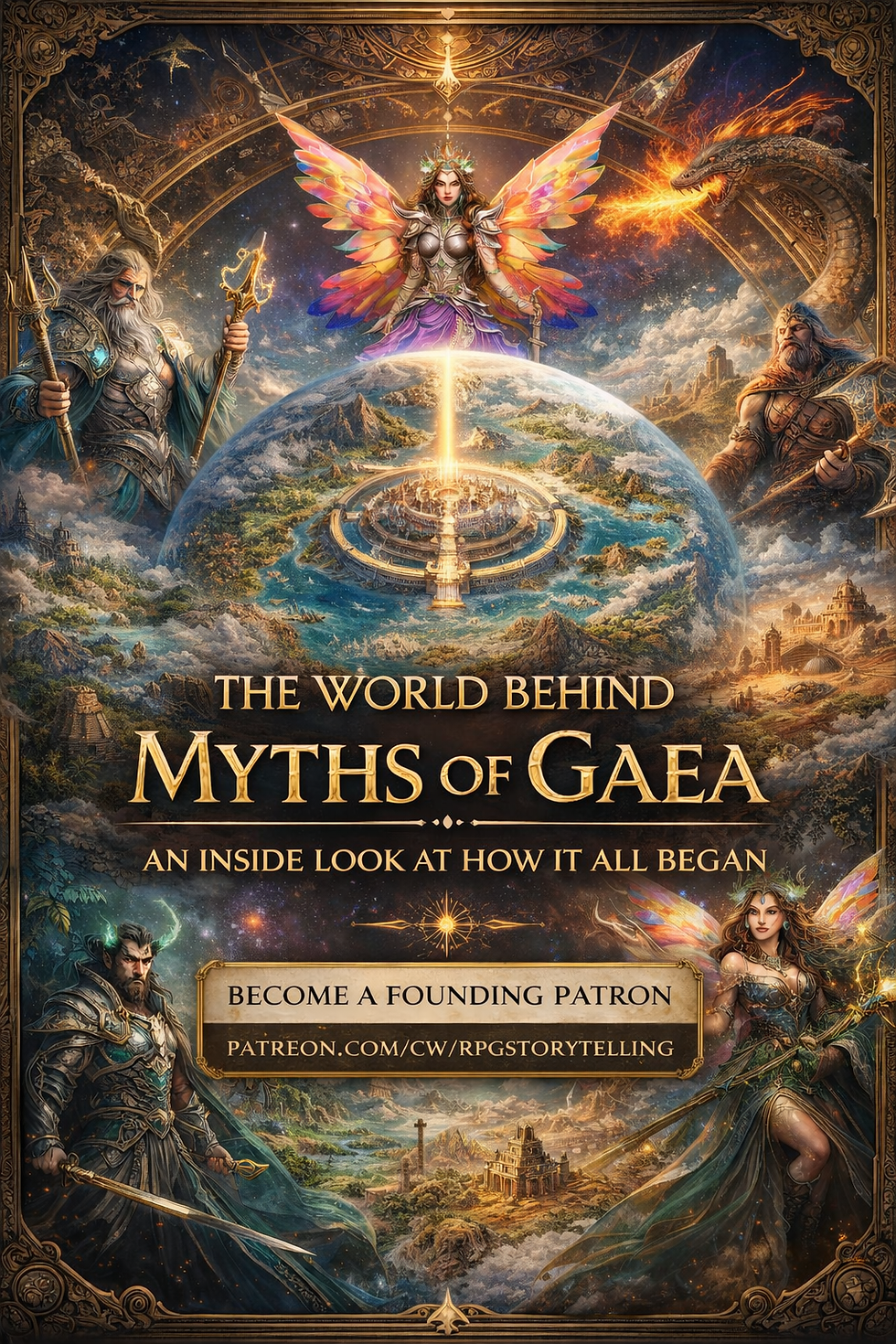
That approach began to crystallize when I commissioned the first official piece of art for the project: a Fae deity inspired by the Celtic goddess Danu. The result was stunning -- an ethereal figure with radiant wings, glowing emerald jewelry, and a gown of violet and flame that shimmered with otherworldly presence. She embodied the vibrancy, grace, and divine power of the Fae realm, but more importantly, she served as a visual ambassador for what Myths of Gaea could be.

That image become more than just a character portrait -- it became a tone-setter. It showed me, and everyone who saw it, that Myths of Gaea wasn't just going to be another sword-and-sorcery fantasy game. It was going to be a celebration of visual diversity, with each culture and pantheon getting its own aesthetic fingerprint.
Art plays a vital role in worldbuilding because it allows players to see what they feel. When players explore the jade temples of a sun-worshipping empire, or witness a sea goddess rising from storm-tossed waves, the visuals help anchor the imagination in something tangible. It's more than illustration -- it's immersion.
I've had the privilege of working with a few talented artists so far, and each one has brought something new to the table. As Myths of Gaea continues to grow, I plan to collaborate with artists from diverse cultural backgrounds -- not just to commission visuals, but to co-create representations that are meaningful, nuanced, and authentic.
That's the goal: not just to make Gaea look beautiful, but to make it feel real. Through armor design, architecture, creature anatomy, and divine iconography, the art of Gaea reflects a world where every detail tells a story -- and every image invites you to step inside.
Milestones and Breakthrough Moments
Every great creation has its thresholds -- the quiet milestones and powerful breakthroughs that shape the journey. For Myths of Gaea, those moments have come not with fanfare, but with clarity. They're the moments when ideas became systems, when visions solidified into lore, and when the people around the table smiled and said, "That was incredible."
We're still in the process of building the first fully playable prototype, but we've already conducted numerous successful playtests of our core systems and mechanics. These playtests haven't just been stress tests -- they've been joyful, collaborative experiences where players connected with the world, immersed themselves in its rhythms, and had fun. That validation -- that spark of enjoyment and curiosity -- is a milestone of its own. Because ultimately, if the game isn't fun, nothing else matters.
One particularly meaningful breakthrough came during the development of Atlantis. While many fantasy world reference the lost city, we returned to the source -- Plato's writings. What we found wasn't a vague myth, but a detailed philosophical framework: a moral story about hubris, divine wrath, and a society that rose too far, too fast. Plato's descriptions provided geography, power structures, and mythic symbolisms that allowed us to ground Atlantis in something profound. It wasn't just a fantasy locations -- it became a narrative keystone, bridging real-world philosophy with speculative myth-making.
Community milestones have also continued to grow.
Our daily and weekly social media posts, paired with thoughtful blog content, have helped steadily increase awareness, bringing Myths of Gaea into the conversation among TTRPG enthusiasts and myth lovers alike. Our livestream campaigns have attracted a growing audience of players and supporters, many of whom offer feedback, encouragement, and creative suggestions that help guid development. That kind of active engagement -- the kind that creates dialogue, not just attention -- is a milestone we're incredibly proud of.
Preparing for our Patreon launch became its own rite of passage. We knew from the beginning that the tier system couldn't feel generic. Instead, we asked: What are the roles in a mythic world?
We structured our tiers around those roles:
Citizens of Gaea represent the lore seekers, the worldbuilders, the Myth Keepers, and the enthusiasts of myth and culture. This tier is for those who want to dig deep into the stories behind the system.
Champions of Gaea are the players -- the heroes in motion. This tier delivers everything a player needs to create their own living legend.
Myth Keepers walk both paths. They oversee campaigns, shape narrative arcs, and require the full breadth of player and lore content to weave unforgettable adventures.
Lyceum Archivists are the co-creators. They move beyond participation and into stewardship -- playtesting, offering feedback, and shaping the very rules and frameworks of the game itself.
The structure wasn't built around monetizations -- it was built around identity. Around purpose. Around participation. Each tier invites people not just to consume the world -- but to inhabit it.
Challenges Along the Way
Like any long and meaningful creative project, Myths of Gaea has had its fair share of resistance -- creative, logistical, and emotional. And yet, each challenge has become a forge, shaping the work into something stronger and more refined.
One of the most persistent hurdles has been the familiar -- and unavoidable -- enemy of all creatives: burnout. Drafting and worldbuilding a project of this scope isn't just a matter of writing rules or names regions; it's an emotional marathon. There have been times when inspiration evaporated, when the spark dimmed, and when I stared at the keyboard with nothing but static in my head.
But I've learned not to panic.
In those moments, I've developed a ritual -- one rooted in the same sources that first inspired this world. I step away. I seek stories. I chase myth. I immerse myself in the movies, books, artwork, television, and music that first ignited the vision of Gaea in my mind. And somewhere between the brushstrokes of a painting and the rising swell of a cinematic score, my Muse returns -- fresh from her mythic vacation, ready to guide the next chapter.
It's not always fast. But it's always real and rewarding.
Another challenge has been more structural. To this point, Myths of Gaea has been, in many ways, a solo endeavor. As the Founder and CEO of RPG Storytelling LLC -- and currently its sole employee -- I've poured countless hours into the game's development, design, and marketing. And while the work is fulfilling, there's a truth that rings louder each day: this world is ready for more voices.

Myths of Gaea isn't meant to be created in isolation. It's too big, too layered, too resonant. What it needs -- what it deserves -- is a team of like-minded creatives. Writes who love lore. Artists who see the divine in every sketch. Mythologists who understand the sacred weight of story. Games Masters and players who want to test, refine, and elevate every mechanic. I am actively seeking collaborators to help bring this vision to life -- not just to lighten the load, but to deepen the world through shared imagination.
Until then, I keep building. Each day, I return to the world that brings me joy. I continue designing systems, writing lore, and dreaming of a day when Myths of Gaea will stand among the greats -- not because of flashy marketing or fast production, but because of the heart, reverence, and craftsmanship that shaped it.
It won't be easy. But even if I have to finish every page myself (though I'll gladly accept help -- wink wink), I believe this is a story worth telling. And I believe there are people -- players, teachers, seekers, storytellers -- who will one day find something meaningful in its pages.
That belief makes every challenge worth it.
What Myths of Gaea Means to Me
If I had to choose one feeling I hope Myths of Gaea inspired in players, it's elation -- that moment when someone leans back from the table, eyes wide, heart full, and says, "That was incredible." But it's not just about epic battles or dramatic roleplay. It's about something deeper. It's about feeling part of something so creative and beautifully tailored, they don't even realize they're also learning. They're discovering the legends of their own world -- its histories, its mythologies, its voices -- through the lens of play.
That's the dream. That's the magic I chase every time I sit down to build Gaea.
The best feedback I could every receive from a GM or a player? Just one word: "MORE."
More lore. More regions. More pantheons. More quests. More time in this world that blends myth, meaning, and memory. I would love to hear someone say, "I couldn't imagine playing anywhere else." That the stories of Gaea made their sessions unforgettable. That they walked away feeling more connected -- not just to the fantasy, but to the real world myths that inspired it.
And here's the truth: I can't build that alone.
While Myths of Gaea began as a solo project, it was never meant to stay that way. As we share more content with the public and our playtesters, I read every comment, every suggestion, every critique. Feedback isn't a box to check -- it's a gift. Because I know deeply and honestly, that I can't know every culture, every story, every sacred truth on my own.
So I listen. I learn. I adapt.
And as Myths of Gaea grows, it becomes more inclusive, more layered, and more powerful -- because of the voices that shape it alongside me. This game is a celebration of our planet's myths. But it's also a celebration of the people who carry them forward.
Looking Toward the Future
The horizon for Myths of Gaea is wide -- and glowing.
RIght now, much of our creative energy is focused on fleshing out the ancient history of the world, crafting a creation myth drawn from Greek cosmology but reimagined through Gaea's unique lens. We're build the foundations -- both literal and mythic -- so that every region, kingdom, and divine force in the world feels connected by time, tension, and transformation.
But beyond that groundwork, I'm incredibly excited to begin sharing the tools that will empower players to bring their own stories to life.
Soon, we'll be rolling out a robust assortment of early content for Champions -- new character species, unique subclasses, culturally rooted background and feats, never-before-seen-spells, and magic items forged by ancient gods and mythic civilizations. These aren't just stat blocks -- they're narrative instruments, each designed to enrich the experience of stepping into a character who feels truly at home in this world.
We're also preparing lore expansions on the factions and organizations that shape Gaea's spiritual, political, and cultural landscapes. These groups bring tension, intrigue, and world-shaping influence to every campaign -- whether players align with them, rebel against them, or uncover their deepest secrets.
In the long term, we're aiming to publish a series of full-length sourcebooks, each designed to offer a unique doorway into the world:
The Myth Keeper's Guide will provide Game Masters with a treasure trove of lore, tools, and story hooks -- complementary to, but distinct from, systems like the Dungeon Master's Guide.
The Champion's Handbook will give players everything they need to create bold, nuanced adventurers -- our Champions -- complete with species, subclasses, and narrative-building mechanics designed specifically for Gaea.
Gods & Kingdoms will unveil the divine and political intricacies of our first two continents: Haeslios (inspired by the British Isles) and Krioslos (inspired by Europe). From sprawling empires to forest enclaves, and from deities to ascendant spirits, this book will be a mythic atlas for worldbuilders and explorers alike.
Future volumes will expand even further -- reskinning other continents from Earth into the mythic ecosystems of Gaea, and diving deeper into the global pantheons, cultural frameworks, and storytelling systems that make the game so vibrant.

But even more exciting that the content is the community we hope to build around it.
Yes, we want Game Masters and players. But we also want mythologists, historians, poets, folklorists, educators, artists, and dreamers. We want those who have stories in their bones. Those who grew up under stars listening to legends. Those who see fairy tales not as fantasy, but as cultural memory.
Myths of Gaea isn't just a game. It's a gathering place. And our community will be its truest magic.
A World Built from Story
Myths of Gaea didn't appear fully formed. It was crafted -- sometimes painstakingly, sometimes joyfully -- across late nights, inspired days, quiet doubts, and sudden breakthroughs. It grew from a love of myth and a need to create. It emerged from the deep belief that stories don't just entertain us -- they connect us, define us, and call us to be more.
This article isn't just a behind-the-scenes reveal. It's an invitation.
Whether you're a player looking for a new world to explore, a Game Master eager to run stories rich with cultural weight, an artist ready to help visualize a mythic planet, or a scholar who wants to bring real-world mythology into creative expression -- you have a place here.
Myths of Gaea is still unfolding.
And I would be honored for you to help shape what comes next.
Together, we won't just play in a world of myth. We'll build one.


Comments